AST/ALT · APRI · FIB‑4
Enter values to calculate
AST/ALT Ratio
—
APRI Score
—
FIB‑4 Index
—
This liver function calculator is an informational tool and does not diagnose disease. AST, ALT, APRI, and FIB‑4 values can shift with acute illness, medications, alcohol use, exercise, and lab variability. Discuss results with a clinician familiar with your history.
Educational tool, not medical advice. Check this tool’s method and limitations before interpreting a result. Talk to a qualified healthcare professional before making decisions about medication, diet, exercise, or treatment. See our Terms of Use.
Your rating helps improve Liver Function Calculator — AST/ALT, APRI, FIB‑4. We store only an anonymized vote (no personal data).
How to Use Liver Function Calculator — AST/ALT, APRI, FIB‑4
Step 1: Enter Your Age
Type your age in years (18 or older). The FIB‑4 calculator uses age to adjust fibrosis risk thresholds.
Step 2: Add Liver Enzymes
Enter AST and ALT values in U/L from the same liver function test (LFT) report.
Step 3: Add Platelet Count
Enter your platelet count in 10⁹/L as printed on your blood work report.
Step 4: Set AST Upper Limit
Enter your lab's AST upper limit of normal (ULN) for accurate APRI scoring. Default is 40 U/L.
Step 5: Calculate Liver Scores
Tap Calculate to see your AST/ALT ratio, APRI score, and FIB‑4 index with color‑coded risk interpretation.
Key Features
- AST/ALT ratio (De Ritis index)
- APRI fibrosis screening score
- Age‑adjusted FIB‑4 index
- Custom AST upper limit of normal
- Combined risk interpretation
- Score reference table
Understanding Your Liver Score Results
How This Liver Function Calculator Works
This liver function calculator computes three non‑invasive liver scores from your routine blood work: the AST/ALT ratio, the APRI score (AST to Platelet Ratio Index), and the FIB‑4 index. Together, these liver function test scores provide a structured view of fibrosis risk that you can discuss with your clinician.
Formulas Used by This Liver Score Calculator
AST/ALT ratio = AST ÷ ALT (both in U/L from the same blood draw). This De Ritis index describes relative changes in liver enzymes and is one of the simplest liver scoring methods.
APRI score = (AST ÷ AST ULN) × 100 ÷ platelets (10⁹/L). The APRI calculator estimates the probability of significant hepatic fibrosis using enzyme elevation relative to normal and platelet count.
FIB‑4 index = (Age × AST) ÷ (Platelets × √ALT). The FIB‑4 calculator combines age and common labs to stratify advanced fibrosis risk. For adults over 65, a higher “low‑risk” threshold of 2.0 is automatically applied.
Reference Ranges & Liver Score Interpretation
- AST/ALT ratio: < 1 is common in many benign states; ≈1 is ambiguous; ≥2 has been associated with patterns seen in alcoholic hepatitis or advanced fibrosis, but is not specific on its own.
- APRI score: <0.5 low probability of significant fibrosis; 0.5–1.5 indeterminate; ≥1.5 suggests significant fibrosis (cutoffs vary by source and clinical context).
- FIB‑4 index: For age ≤65: <1.3 low risk, 1.3–2.67 indeterminate, >2.67 high risk. For age >65: <2.0 low risk, 2.0–2.67 indeterminate, >2.67 high risk.
Assumptions & Limitations
These liver scores are screening aids and not diagnoses. Acute illness, medications, alcohol, strenuous exercise, hemolysis, and non‑liver sources of AST can change results. Always interpret alongside the absolute enzyme values, your lab's reference ranges, symptoms, imaging, and clinician guidance.
Complete Guide: Liver Function Calculator — AST/ALT, APRI, FIB‑4
On this page
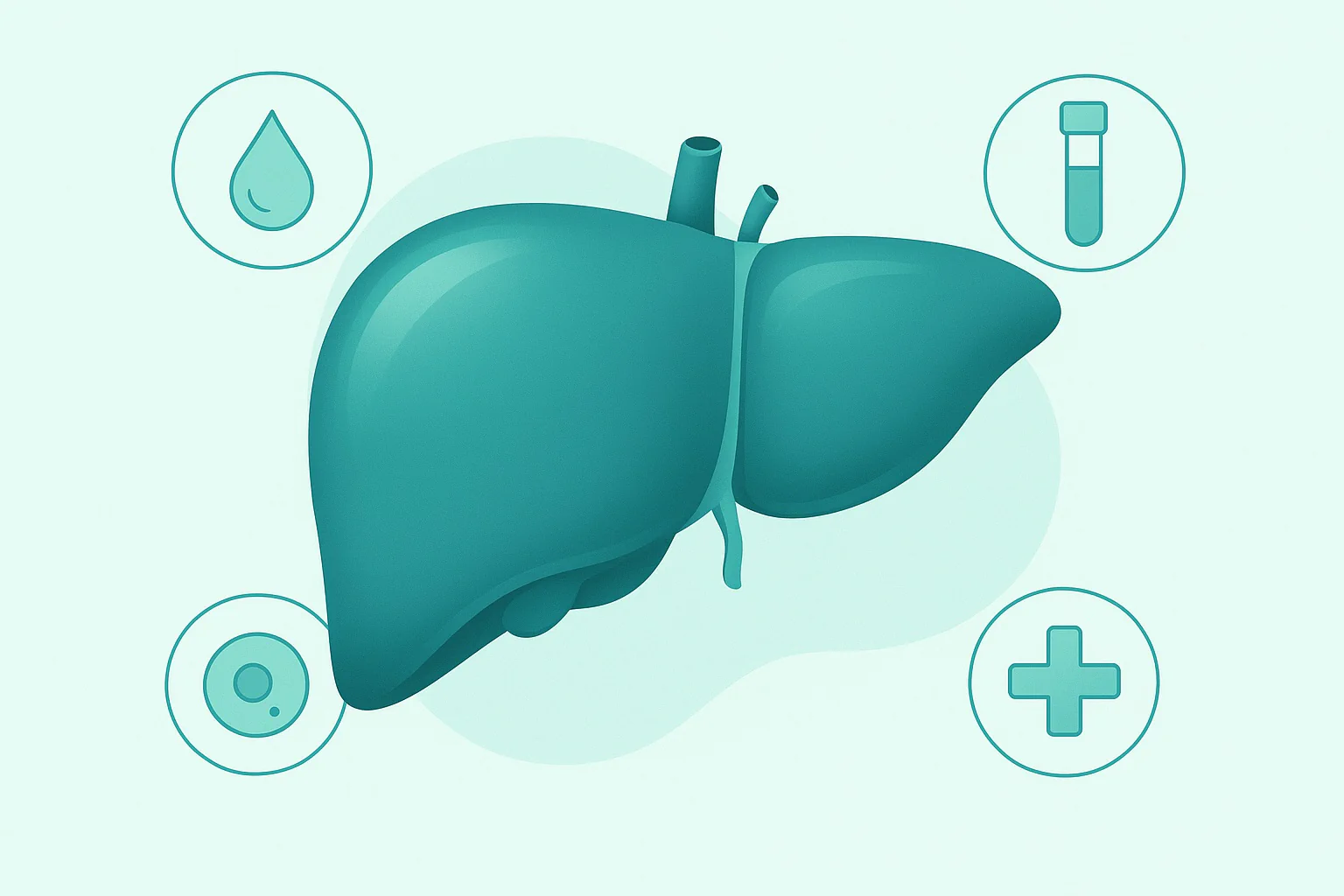
This liver function calculator turns routine blood work into structured liver scores. Enter your age, AST, ALT, platelet count, and your lab's AST upper limit of normal (ULN), and the tool instantly computes three widely used non‑invasive indices: the AST/ALT ratio (De Ritis index), APRI score, and FIB‑4 index. These liver scores help you and your clinician assess the probability of significant liver fibrosis without imaging or biopsy.
A liver function test calculator like this one is a planning tool, not a diagnosis. Your clinician will weigh these scores alongside symptoms, exam findings, medications, alcohol exposure, viral hepatitis status, metabolic risks, and imaging. Use this page to better understand what you see on your lab report and to prepare clear questions for your next visit.
What this liver function calculator does
The goal of this liver function calculator is to convert a few numbers from your liver function test (LFT) results into structured, understandable information. It uses three non‑invasive scoring methods commonly referenced in hepatology and primary care:
- AST/ALT ratio (De Ritis index): a simple division — AST ÷ ALT — showing relative change between these liver enzymes. It is one of the oldest liver scoring tools in clinical use.
- APRI score (AST to Platelet Ratio Index): (AST ÷ AST ULN) × 100 ÷ platelets. This APRI calculator component estimates the probability of significant hepatic fibrosis using enzyme elevation relative to normal and platelet count.
- FIB‑4 index: (Age × AST) ÷ (Platelets × √ALT). This FIB‑4 calculator component combines age with common lab values to stratify advanced fibrosis risk. It is widely used as a first‑line screening tool in primary care.
These scores are decision aids, not definitive tests. They can be influenced by temporary conditions such as acute illness, exercise, or medications. For example, AST is also present in skeletal muscle, so intense workouts or muscle injury may raise AST and shift the AST/ALT ratio without a primary liver problem. Platelets may be low for many reasons beyond liver disease. That is why the calculator highlights ranges and context, not binary diagnoses.
Inputs and units you'll need
This liver enzyme calculator requires four lab values and one reference value, all from the same blood draw:
- Age in years (18 or older).
- AST (aspartate aminotransferase) in U/L.
- ALT (alanine aminotransferase) in U/L.
- Platelets in 10⁹/L (sometimes written as ×10⁹/L on lab reports).
- AST ULN (your laboratory's upper limit of normal for AST) — 40 U/L is common, but your lab's exact value should be used for the most accurate APRI calculation.
Consistency matters. Use results printed on the same report and do not mix numbers from different dates. If your lab uses different reference intervals, simply enter the ULN shown on your report; this keeps the APRI score tailored to your testing method.
How APRI, FIB‑4, and AST/ALT ratio are calculated
AST/ALT ratio is straightforward: divide AST by ALT (both U/L). Values less than 1 are common and can be seen in many benign states. A ratio close to 1 is ambiguous and needs context. Ratios at or above 2 have been described in patterns seen with alcoholic hepatitis or advanced fibrosis, but the ratio alone is not specific enough for diagnosis.
APRI score compares AST to the upper limit of normal and adjusts for the platelet count: (AST ÷ AST ULN) × 100 ÷ platelets. In general, a lower APRI suggests lower probability of significant fibrosis; higher APRI suggests increased probability. Many clinical pathways use <0.5 as low probability, 0.5–1.5 as indeterminate, and ≥1.5 as suggestive of significant fibrosis, though thresholds vary by source and population.
FIB‑4 index = (Age × AST) ÷ (Platelets × √ALT). For adults up to age 65, a FIB‑4 below 1.3 is often considered low risk of advanced fibrosis, 1.3–2.67 indeterminate, and above 2.67 higher risk. In adults over 65, some clinical pathways use a more conservative low‑risk cutoff of 2.0 before calling results indeterminate. This FIB‑4 calculator applies the age‑adjusted low‑risk threshold automatically.
Interpreting your liver score results
Use all three outputs together and read them alongside the absolute enzyme values on your lab report. For example, a mildly elevated ALT with an AST/ALT ratio below 1, a low APRI, and a low FIB‑4 may point toward lower probability of advanced fibrosis. In contrast, elevated AST and ALT with a ratio near or above 2, an APRI above 1.5, and a FIB‑4 above 2.67 are all signals that additional evaluation may be warranted.
- Low‑risk profile: APRI < 0.5 and FIB‑4 below the age‑adjusted low cutoff (1.3 if ≤65; 2.0 if >65) with modest enzyme elevations.
- Indeterminate: APRI 0.5–1.5 and FIB‑4 between the low and high cutoffs. Repeat testing, trend review, or ultrasound may be suggested by your clinician.
- Higher‑risk profile: APRI ≥ 1.5 or FIB‑4 > 2.67, especially if the AST/ALT ratio is ≥ 2 and platelet count is low (our platelet count calculator grades how low it really is). Discuss next steps with your clinician promptly.
APRI, FIB‑4, and AST/ALT ratio at a glance
Think of these liver scores as risk stratification tools, not diagnoses. A low APRI score and low FIB‑4 index, together with modest enzyme elevations, usually point toward lower short‑term concern for advanced fibrosis. Indeterminate ranges invite a closer look at trends, ultrasound, or repeat labs after a period of steady routines. High‑risk results are a cue to connect with your clinician for next steps. Use this liver function calculator to organize the numbers, then rely on professional judgement for decisions.
If your clinician is considering cirrhosis severity or transplant prioritization, other tools may be used. For example, the Child‑Pugh calculator summarizes overall hepatic function using albumin, bilirubin, INR, ascites, and encephalopathy. The MELD score calculator estimates short‑term mortality risk in advanced liver disease. Those tools serve different purposes than non‑invasive screening indices like the APRI score or FIB‑4 index computed by this liver function calculator.
Who should use a liver function test calculator
This liver score calculator is useful for anyone who has received liver function test (LFT) results and wants to understand them better before their next appointment. Common situations include:
- Routine health screening: Liver enzymes are often part of a comprehensive metabolic panel. If your AST or ALT is flagged, running the APRI and FIB‑4 calculations helps contextualize whether fibrosis screening is warranted.
- Chronic hepatitis B or C monitoring: APRI and FIB‑4 were originally validated in hepatitis C populations and remain widely used for tracking fibrosis progression in chronic viral hepatitis.
- Metabolic‑associated fatty liver disease (MAFLD): Primary care guidelines increasingly use FIB‑4 as a first‑line screen to identify patients who need specialist referral for non‑alcoholic or metabolic fatty liver disease.
- Alcohol‑related liver concerns: When the AST/ALT ratio trends above 2, clinicians often investigate alcohol‑related patterns. This calculator provides that ratio alongside APRI and FIB‑4 for a fuller picture.
- Pre‑operative or insurance assessments: Some evaluations request liver scoring as part of a risk profile. Having your APRI and FIB‑4 ready saves time and supports informed discussions.
Common scenarios and clinical examples
1) Mild enzyme elevations after strenuous exercise. If you recently completed a hard workout, AST may rise more than ALT because AST is present in muscle. The AST/ALT ratio can shift upward even when the liver is not the main source. In such cases, both the APRI score and FIB‑4 index may still read low risk if platelets are normal and the absolute enzyme values are only slightly elevated. Time and repeat testing often clarify whether this is a transient pattern.
2) Metabolic risk and fatty liver. In people with metabolic syndrome, diabetes, or obesity, ALT may be higher than AST (ratio <1), but the scale of elevation and trends matter. A low FIB‑4 helps rule out advanced fibrosis in many primary‑care pathways. Our dedicated AST/ALT ratio calculator can help you focus on the De Ritis index alone if needed, but the FIB‑4 index often adds more context.
3) Suspected alcohol‑related liver disease. When the AST/ALT ratio is around 2 or higher and liver enzymes are elevated, clinicians sometimes describe this as a pattern seen with alcohol‑related injury. It is not specific. Platelets, bilirubin, albumin, and INR — none of which are used by APRI or FIB‑4 — are often reviewed alongside history, imaging, and exam. Because a falling albumin is one of the earliest markers of reduced liver synthesis, our albumin calculator grades how low it is and what that suggests. If alcohol is a concern, our alcohol units calculator can help you quantify intake in standardized units.
4) Chronic viral hepatitis or long‑standing disease. Non‑invasive liver scores may trend upward over time as fibrosis advances, but acute flares can also raise liver enzymes suddenly. Consistency in timing and using the same lab help with interpretation. Advanced assessments may include elastography or biopsy, which are beyond this calculator's scope.
5) Medication‑induced liver enzyme elevation. Certain medications — including statins, acetaminophen (paracetamol), some antibiotics, and herbal supplements — can elevate AST and ALT. When liver function tests show elevated enzymes in the context of a new medication, the APRI and FIB‑4 may help your clinician determine whether fibrosis risk has changed or if the elevation is pharmacological and self‑limiting.
Lifestyle factors and liver health
Many factors that support overall health also support liver function. Maintaining a healthy weight, moderating alcohol, managing diabetes and lipids, reviewing medications and supplements with your clinician, staying up‑to‑date on vaccinations (such as hepatitis A and B), and building a regular sleep and activity routine all contribute to better liver outcomes. None of this replaces a tailored plan from a professional who knows your history, but it shows why trends in liver function tests are often read in the context of day‑to‑day habits.
Beyond the liver, kidney function and general metabolic health can influence decision making in advanced disease. If you are tracking broader health markers, our kidney function calculator and A1C calculator provide quick context for related labs. For weight and nutrition planning, you can also browse our full calculators index to find tools that fit your goals.
When to seek medical care
Seek medical care promptly if you have yellowing of the skin or eyes (jaundice), dark urine, pale stools, confusion, easy bruising, severe abdominal pain, vomiting blood, or black tarry stools. These symptoms can signal urgent problems and warrant immediate evaluation. Even without alarm symptoms, persistently elevated liver enzymes, rising APRI or FIB‑4 scores, or a high‑risk FIB‑4 (>2.67) are good reasons to follow up with a clinician. Never start or stop medicines based solely on a liver score from a calculator.
Related calculators and next steps
- FIB-4 Calculator: Scores advanced liver fibrosis risk from age, AST, ALT, and platelet count — the first-line non-invasive screen.
- AST/ALT Ratio Calculator: Focus on the De Ritis index alone with a compact UI and interpretation notes.
- Child‑Pugh Calculator: Summarizes cirrhosis severity using labs and clinical findings.
- MELD Score Calculator: Estimates short‑term mortality risk used in transplant triage.
- Alcohol Units Calculator: Convert drinks to standardized units to better quantify exposure.
- Kidney Function Calculator: Context for renal labs that may interact with liver care in advanced disease.
- Blood Type Calculator: Understand blood type inheritance and compatibility — useful context for any lab work review.
To keep everything organized, bookmark our full calculators index. When you are ready, return to the top of this page to enter your numbers or update them after a new lab draw.
Guide FAQs
Do I need fasting for liver function tests? Most labs do not require fasting for AST or ALT. The more important practice is using results from the same blood draw and following your lab's instructions for timing and medications.
Why use my lab's AST ULN in the APRI calculator? The APRI score calibrates AST to your lab's "normal" range. Because reference intervals vary by method and population, the ULN printed on your report is the best anchor for an accurate APRI calculation.
What if my APRI and FIB‑4 scores disagree? That can happen. The APRI score and FIB‑4 index emphasize different aspects of liver disease biology — enzyme elevation versus platelet trends and age. Clinicians often repeat labs, review trends, and add imaging when scores conflict.
Is FIB‑4 accurate for all age groups? FIB‑4 was originally validated in adults aged 35–65. For patients over 65, a higher low‑risk cutoff of 2.0 is recommended to reduce false positives. For patients under 35, FIB‑4 may underestimate risk. This liver function calculator automatically applies the age‑adjusted cutoff for patients over 65.
Where can I learn more about liver function tests? For general background, reliable sources include the NIDDK liver disease page, the American Liver Foundation, and the American Association for the Study of Liver Diseases (AASLD). Always use official health sites for evidence‑based information.
References
- National Institute of Diabetes and Digestive and Kidney Diseases (NIDDK). Liver Disease Information. U.S. Department of Health and Human Services.
- American Liver Foundation. Liver Function Tests. Accessed 2026.
This guide is informational and does not provide medical advice. It does not replace diagnosis, clinical judgment, or personalized care.

Written by Jurica Šinko
Founder & CEO
Entrepreneur and health information advocate, passionate about making health calculations accessible to everyone through intuitive digital tools.
View full profileFrequently Asked Questions
What does this liver function calculator measure?
It computes the AST/ALT ratio, APRI, and FIB‑4 from your age, AST, ALT, platelets, and AST ULN. These non‑invasive scores help contextualize liver lab results and the chance of significant fibrosis.
Which units should I use for labs?
Enter AST and ALT in U/L and platelets in 10^9/L (sometimes written as ×10^9/L). Use your laboratory's AST upper limit of normal (ULN), commonly ~40 U/L, unless your report lists a different value.
Is a high APRI or FIB‑4 a diagnosis?
No. APRI and FIB‑4 are screening tools. A high score suggests a higher chance of advanced fibrosis, but imaging, repeat labs, and clinical evaluation are needed to confirm or rule out disease.
Why does FIB‑4 use age and square root of ALT?
FIB‑4 incorporates age because fibrosis risk rises with age, and it uses AST, ALT, and platelets to reflect inflammation and portal pressure. ALT enters the formula under a square‑root to balance its influence.
Do I need fasting for AST or ALT?
Fasting is usually not required. The most important practice is using results from the same blood draw and following your lab's instructions for consistency.
Can exercise raise AST and affect the AST/ALT ratio?
Yes. AST exists in muscle, so intense exercise, muscle injury, or hemolysis can raise AST more than ALT and shift the ratio without a primary liver disorder.
Will you store my data?
No. This tool is privacy‑first and does not store your inputs. If you want to keep a copy, you can screenshot or copy the result text.
How is a liver score calculated from blood work?
A liver score such as APRI or FIB‑4 uses routine blood test values — AST, ALT, platelet count, and age — to estimate fibrosis risk without invasive procedures. APRI divides AST by its upper limit of normal and adjusts for platelets, while FIB‑4 factors in age and the square root of ALT. This liver function calculator computes both scores and the AST/ALT ratio simultaneously from one set of lab inputs.
Related Calculators

A1C Calculator — Convert HbA1c to eAG with Targets
Use our A1C calculator to convert HbA1c to estimated average glucose (eAG). See normal, prediabetes, and diabetes thresholds in mg/dL and mmol/L. Fast results.

Albumin Calculator — Serum Albumin Level Interpretation
Free albumin calculator to interpret serum albumin levels, grade hypoalbuminemia, and compute A/G ratio plus albumin-corrected calcium from your lab results.
Albumin-Corrected Anion Gap Calculator — Hidden Acidosis
Use our albumin-corrected anion gap calculator to raise the anion gap by 2.5 per 1 g/dL of low albumin and reveal a hidden high-gap metabolic acidosis.

ANC Calculator: Absolute Neutrophil Count & Neutropenia
Free ANC calculator to calculate absolute neutrophil count from WBC and differential. Get ANC in cells/uL and x10^9/L with instant neutropenia grading.
Anion Gap Calculator — Metabolic Acidosis Evaluation
Free anion gap calculator finds serum anion gap from sodium, chloride, and bicarbonate, with albumin correction and delta ratio for metabolic acidosis.
AST/ALT Ratio Calculator — Free De Ritis Ratio Tool
Use our free AST/ALT ratio calculator to compute the De Ritis index instantly. Visual ratio chart, enzyme-level assessment, and clinical patterns guide.