Nicotine Calculator — Daily Intake & Vape-to-Cigarette Conversion
1Smoking
Typical absorbed nicotine is roughly 1.0–1.8 mg per cigarette. Individual delivery varies by brand and smoking style.
2Vaping
Daily Nicotine Intake
Heavy useCigarette equivalents use your selected mg per cigarette. NRT patch guidance is approximate — always follow product labels and consult a pharmacist.
Educational tool, not medical advice. Check this tool’s method and limitations before interpreting a result. Talk to a qualified healthcare professional before making decisions about medication, diet, exercise, or treatment. See our Terms of Use.
Your rating helps improve Nicotine Calculator — Intake & E‑Liquid Planner. We store only an anonymized vote (no personal data).
How to Use Nicotine Calculator — Intake & E‑Liquid Planner
Step 1: Pick a mode
Choose Nicotine Intake to estimate your daily mg from smoking and vaping, or E‑Liquid Mix to plan a bottle with PG/VG ratios.
Step 2: Enter smoking and vaping details
Add cigarettes/day and mg per cigarette for smoking. For vaping, enter your e‑liquid nicotine strength (mg/mL) and choose between mL/day or puffs/day tracking.
Step 3: Read your nicotine totals
See nicotine from smoking, from vaping, the combined daily dose, cigarette equivalents, and approximate NRT nicotine patch guidance.
Step 4: Plan a step‑down schedule
Enable the step‑down planner to choose weeks and a weekly reduction percentage. The schedule shows target mg/day with a visual progress bar.
Step 5: Mix an e‑liquid bottle
Switch to E‑Liquid Mix and enter target strength, base strength, PG/VG ratio, and flavor percentage. Get exact pour volumes for each component.
Key Features
- Daily nicotine intake from smoking and vaping
- Vape-to-cigarette nicotine conversion
- NRT patch dose guidance
- Weekly step‑down reduction planner
- E‑liquid mixing with PG/VG and flavor
- Privacy‑first — no data stored
Understanding Your Nicotine Calculator Results
Nicotine Intake Formula
Daily nicotine from smoking equals cigarettes/day × mg absorbed per cigarette. Daily nicotine from vaping equals mL/day × e‑liquid strength (mg/mL). This nicotine calculator adds both sources to show a combined mg/day total and a cigarette equivalent based on your selected mg/cigarette value.
If you track puffs instead of mL, toggle to "Puffs per day" mode. The tool estimates mL from your device's mL-per-100-puffs rate: (puffs ÷ 100) × mL/100 puffs. The estimated mL/day is shown in real time so you can verify it matches your refill pattern.
Vape-to-Cigarette Conversion
The vape-to-cigarette conversion divides your total daily nicotine by the absorbed mg per cigarette to produce a familiar "cigarette equivalent" number. This is useful for comparing your vaping nicotine dose to traditional smoking, understanding how much nicotine you consume relative to cigarettes, and communicating with healthcare providers who may think in cigarette-per-day terms.
Nicotine Patch Dose Guidance
The nicotine patch calculator guidance maps your daily intake to standard NRT patch strengths: 21 mg/24h for heavy use (over ~25 cigarette equivalents or 30 mg/day), 14 mg/24h for moderate use, and 7 mg/24h for light use. This follows general NRT guidelines, but individual needs vary. Always consult product labels and a pharmacist or clinician before starting nicotine replacement therapy.
Reference Ranges & Interpretation
There is no single "good" or "bad" daily nicotine number; the goal is to understand your baseline so you can adjust deliberately. The color-coded level indicator (light ≤12 mg, moderate ≤24 mg, heavy 25+ mg) provides rough context. Many users succeed by reducing 5–15% per week rather than making a large jump.
For background on quitting support, review the CDC: Quit Smoking resources and general guidance from the CDC Tobacco information.
Assumptions & Limitations
Nicotine delivery varies with device power, technique, coil type, and formulation. Labeled mg/mL describes liquid concentration, not actual absorption. Cigarette yields differ by brand and smoking style. The vaping nicotine dose estimate treats all labeled nicotine as consumed, which overstates actual absorption. Treat results as planning estimates and consult a professional if uncertain.
Using This Nicotine Intake Calculator
This nicotine intake calculator helps you translate cigarettes, puffs, mL/day, and e‑liquid nicotine strength into a clear mg/day total with vape-to-cigarette conversion and NRT guidance. If you mix your own juice, the e-liquid nicotine calculator mode lets you set a target mg/mL, PG/VG ratio, and flavor base to get exact pour volumes for a bottle. Use it alongside a nicotine step-down plan to reduce intake at a comfortable pace.
Complete Guide: Nicotine Calculator — Intake & E‑Liquid Planner
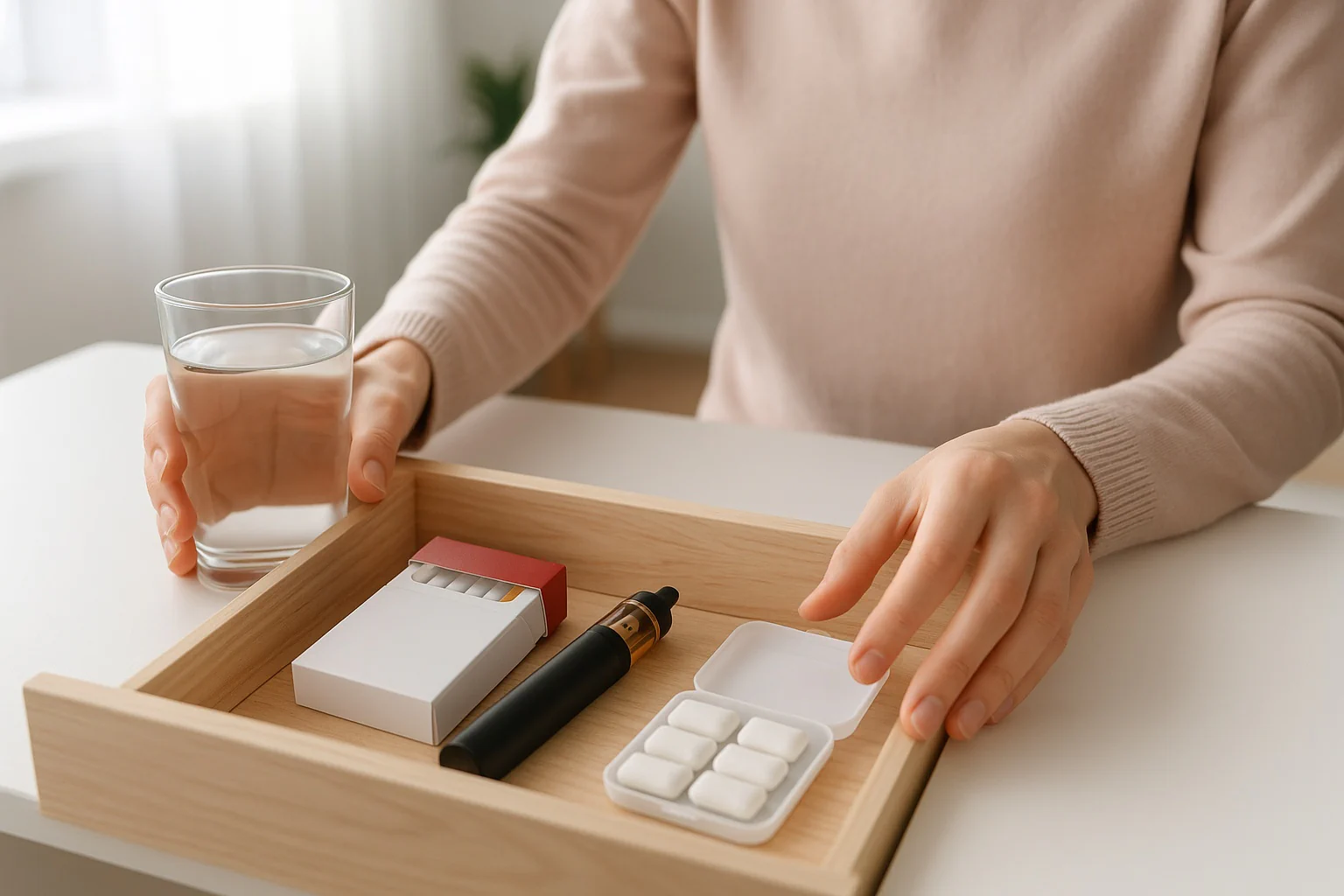
On this page
Free nicotine calculator for daily mg intake, vape-to-cigarette conversion, NRT patch dose guidance, step‑down plans, and e‑liquid mixing with PG/VG ratios.
This nicotine calculator has two main modes. The Intake tab estimates your total nicotine exposure from smoking and/or vaping in milligrams per day, provides vape-to-cigarette conversion, and shows approximate NRT patch dose guidance. The E-Liquid Mix tab lets you plan a bottle: target strength, total volume, nicotine base strength, and PG/VG ratio with flavor percent.
What this nicotine calculator estimates
The tool focuses on practical questions people ask every day. How much nicotine am I getting from my routine? If I switch to vaping, what e-liquid strength makes sense at my current pace? How does my vaping nicotine dose compare to cigarettes? If I want to step down over the next 6–10 weeks, what weekly targets look realistic? These are planning questions, not medical prescriptions. Your choices, context, and preferences still matter most.
Smoking inputs include cigarettes per day and an adjustable "mg absorbed per cigarette." Typical absorbed nicotine falls around 1.0–1.8 mg, though delivery varies by brand, style, and how you smoke. Vaping inputs include an e-liquid nicotine strength in mg/mL and a clear choice between mL/day or puffs/day tracking — there is no guessing about which input the calculator uses.
Your results summarize per-day intake from smoking and vaping, then combine them into a single number. For everyday planning, this "mg/day" total is easier to compare across habits than time-of-day estimates. You also get a quick cigarette equivalent based on your chosen mg-per-cig value, a color-coded usage level (light, moderate, heavy), and approximate nicotine patch dose guidance for anyone considering NRT.
Why mg/day? Because it is a unit that holds steady when your schedule changes. Whether you spread intake evenly or cluster it, the daily total still anchors decisions like selecting a bottle strength or choosing a reasonable weekly reduction. Over time, you can track your mg/day like a budget — a number to steer, not a number to fear.
The nicotine calculator is also privacy-first. Nothing you type is stored or sent to a server. It runs on your device, which means you can experiment without worry. If you prefer paper, jot your numbers down and note how you feel as you adjust. The mix of data and self-awareness is what makes a plan stick.
Nicotine intake formula explained
The equation is intentionally simple and transparent so that you can adjust assumptions as you learn more about your own patterns. Daily nicotine from smoking equals cigarettes per day multiplied by nicotine absorbed per cigarette. Daily nicotine from vaping equals e-liquid mL consumed per day multiplied by the labeled mg per mL. Total daily intake is the sum of those two parts.
If you prefer to track puffs, toggle to "Puffs per day" mode and the calculator translates puffs to mL by multiplying puffs/100 by your device's mL-per-100-puffs estimate. The estimated mL/day shows in real time beneath the input so you can verify it matches how often you refill. This is clearer than the old approach of silently choosing between two inputs.
Keep in mind that labeled strengths are nominal and absorption differs between methods and people. Nicotine delivery can shift with puff duration, device wattage, formulation, and whether you inhale deeply. That is why this nicotine intake calculator is a planning lens, not a clinical device. It is designed to be honest about uncertainty while staying actionable.
What about bioavailability? Nicotine is absorbed through the lungs during smoking and largely through the mouth, throat, and lungs during vaping, with precise fractions depending on technique. Rather than guessing at individual absorption percentages, we let you set the "mg per cigarette" assumption and measure your own mL/day on your device. The estimate improves as your records become more consistent.
If you are experimenting with lower strengths, note that cravings, mood, and sleep quality are useful feedback signals. You might find that a seemingly small change in strength causes bigger behavior changes — more puffs, more frequent sessions — which is why mg/day can drift in both directions. Re-check your totals after a few days at a new level.
Vape-to-cigarette equivalents: how the conversion works
One of the most common questions people search for is "how many cigarettes equals my vaping?" The vape-to-cigarette conversion in this nicotine calculator answers that by dividing your total daily nicotine (from both smoking and vaping) by the absorbed mg per cigarette. If your total is 18 mg/day and you use 1.1 mg per cigarette, your cigarette equivalent is about 16.4.
This crosswalk is not a claim that vaping and smoking carry equal risks — it is a shared unit for comparison. Healthcare providers, NRT product labels, and cessation programs often frame nicotine use in cigarettes per day. Having this number ready helps you communicate your actual intake in terms others recognize, whether you are discussing options with a doctor or comparing to standardized NRT dosing charts.
You can also use cigarette equivalents to spot drift. If a stressful week pushes you from 12 mg/day to 18 mg/day, that might be the equivalent of ~6 extra cigarettes. Seeing that magnitude helps you plan a counter-move for next week — a small strength nudge, a bedtime routine, or simply more daylight walks. The number is a feedback tool, not a judgment.
One thing this crosswalk deliberately does not do is feed a pack-year total. Pack-years measure combustion exposure, so vaping adds zero to that figure no matter how high your cigarette equivalent runs. If you smoked before switching, the pack year calculator totals only the cigarette years — which is the number that decides lung cancer screening eligibility at the 20 pack-year mark.
Keep in mind that the conversion accuracy depends on your mg-per-cigarette setting. If you smoke ultra-light cigarettes, lower this to 0.8–1.0 mg. If you smoke unfiltered or hand-rolled, consider 1.5–2.0 mg. The default of 1.1 mg represents a middle-ground estimate based on published absorption data for standard filtered cigarettes.
Nicotine patch dose guidance
Many people searching for a "nicotine patch calculator" want to know what patch strength matches their current nicotine use. Standard NRT guidelines recommend the 21 mg/24h patch for people smoking more than 10 cigarettes per day, stepping down to 14 mg and then 7 mg over 8–12 weeks. This nicotine calculator maps your computed daily intake and cigarette equivalents to those thresholds to show an approximate starting patch strength.
The patch guidance is deliberately conservative. If your daily total exceeds 30 mg or your cigarette equivalents top 25, the calculator flags "heavy use" and suggests the highest standard patch (21 mg/24h). For lighter users below 12 mg/day or ~10 cigarette equivalents, it suggests the 7 mg patch. Moderate users fall in between at 14 mg.
Important: This guidance is approximate and educational. NRT dosing depends on individual health, other medications, and personal tolerance. Always follow the product label instructions and consult a pharmacist or clinician before starting, combining, or adjusting nicotine replacement products. The calculator is a conversation starter, not a prescription.
E-liquid planner: PG/VG, flavor, strength
The E-Liquid Mix tab helps you build a bottle that matches your goal. Enter your total volume in mL, the target nicotine strength (mg/mL), your nicotine base strength (e.g., 100 mg/mL or 72 mg/mL), select the base solvent (PG or VG), and pick a target PG/VG ratio with your flavor percent. You can also choose whether your flavor concentrate is PG-based or VG-based for a more accurate e-liquid nicotine calculator result.
The core formula is straightforward: nicotine base volume equals total volume multiplied by target strength, divided by nicotine base strength. Flavor is your flavor percent of the total volume. The remainder is split between PG and VG to reach your target ratio after subtracting the PG (or VG) already contributed by nicotine base and flavor concentrate.
If you enter an impossible combination — for example, a very high flavor percent with a strict VG target while using PG-based nicotine — you will see a warning. This prevents surprises such as negative filler values. The solution is to loosen the ratio, reduce flavor percent, or change the nicotine base or flavor solvent. The results also display the actual achieved PG/VG ratio so you can see exactly what you are getting.
Typical starting points: many mouth-to-lung users like 50/50 or 60/40 PG/VG for throat hit and wicking, while direct-to-lung users often prefer 30/70 or 20/80 for smoother clouds. Flavor percentages vary widely by concentrate; 5–12% is common for single-flavor mixes, with some strong concentrates below 5% and multi-flavor blends above 12%.
If you plan to blend two finished bottles to reach an in-between strength or flavor, you can still use the mix tab by treating each bottle as a "component." Enter the combined volume, the target strength, and choose a flavor percent that approximates the mixture. The calculated nicotine base will be zero because the nicotine already exists in the bottles; the result tells you what a fresh mix would have looked like.
Choosing a vape nicotine strength
Choosing a starting e-liquid strength is part art, part math. If you currently smoke, translating your daily total can anchor your first bottle. For instance, someone absorbing ~20 mg per day and using about 3 mL of liquid might start around 6–7 mg/mL (20 ÷ 3). Someone using 5–6 mL per day with the same target might start closer to 3–4 mg/mL. These are planning anchors, not hard rules. Use this vape nicotine calculator to experiment with different combinations.
Preferences matter. Mouth-to-lung setups often pair well with higher strengths and higher PG ratios for throat hit. Direct-to-lung setups usually favor lower nicotine strengths and more VG for smoother vapor. If in doubt, start conservative; it is easier to add puffs or nudge strength than to undo over-strong liquid. Small test bottles help you learn quickly without waste.
If you are considering nicotine replacement therapy (NRT) products instead of or alongside vaping, read the label carefully and follow directions. Product guidance for nicotine patches, gum, and lozenges is based on typical cigarette use patterns. The nicotine patch dose guidance in this calculator can serve as a rough starting point, but always discuss specifics with a clinician or pharmacist.
Watch out for "double counting" when changing both strength and device. For example, moving from a small pod to a high-power tank and dropping strength may not reduce mg/day if your mL/day climbs. Track both numbers for a week to see where you actually land.
Finally, consider timing. Some users keep a slightly higher nicotine strength in the morning and a lower strength later in the day to smooth cravings while keeping daily totals modest. Others do the opposite to avoid overstimulation at bedtime. There is no single correct pattern — only what works well for you.
Step-down strategies that stick
Many people succeed with gentle, predictable reductions such as 5–15% per week. The step-down planner shows a schedule from your current daily total with visual progress bars for each week. Pick a number of weeks and a weekly percentage reduction; the table updates instantly. Some users move in phases — holding a level for two weeks, then reducing — while others prefer a steady weekly glide path. The best plan is the one you can actually follow.
Consider pairing nicotine changes with habit changes: time your first puff later, replace certain "cue" moments, or add a tiny friction step before each session. Track how you feel — energy, mood, sleep — not just the numbers. If a drop feels too aggressive, hold and stabilize. A plan that respects real life beats a perfect plan abandoned in week two.
If you use e-liquid, one practical tactic is to buy progressively lower strengths as you move through your plan. For example, you might spend two to four weeks at 6 mg/mL, then blend remaining liquid with a 3 mg/mL bottle to create ~4–5 mg/mL, and so on. The E-Liquid Mix tab can help you calculate these blends precisely so your transitions are smooth.
Examples help. Suppose your current total is ~24 mg/day. With a 10% weekly reduction, your target would be ~21.6 mg/day in week one, ~19.4 mg/day in week two, and ~17.5 mg/day in week three. If you use ~3 mL/day, that parallels strengths of 7.2 → 6.5 → 5.8 mg/mL. You could reach those with fresh bottles or by blending remaining liquid at each step.
Alternatively, choose a "staggered" approach: reduce 10% every other week, and focus on stabilizing sleep and stress on the in-between weeks. Many people find this gentler pace more sustainable. The point is momentum, not perfection.
If you combine nicotine changes with life changes — a new job, a relocation, a newborn — expect variability. A short plateau is not a failure. Use the planner as a flexible guide, revisit your numbers, and resume reductions when your routine settles.
Safety: handling nicotine base
Nicotine is a potent substance. When mixing e-liquid, work on a stable surface with gloves, keep liquids away from children and pets, and label bottles clearly. Avoid splashes, and wash skin with soap and water if contact occurs. Store nicotine base in child-resistant containers out of reach and, if possible, under lock. Dispose of waste responsibly following your local guidance.
Always follow the instructions that come with nicotine products. This nicotine calculator is for planning and education; it is not medical advice and does not replace your product labels or professional guidance. If you have health conditions, medications, or questions about nicotine's effects, speak with a qualified clinician or pharmacist.
If you spill concentrated nicotine base, ventilate the area, wipe with absorbent material while wearing gloves, and wash the surface with warm soapy water. Do not pour concentrated nicotine down household drains; follow local disposal rules or consult your pharmacy for guidance.
Common pitfalls and myths
- "More mg is always better." Not true. Too much nicotine can feel harsh or cause side effects like nausea or dizziness. Start with enough to avoid withdrawal, not so high that you feel unwell.
- "Lower mg means you will vape less." Often the opposite. If the nicotine strength is too low for your need, you may vape more mL/day to compensate. Track both strength and mL/day for a clearer picture of your vaping nicotine dose.
- "All devices deliver the same." Power, airflow, coil design, and technique all change delivery. That is why this vape nicotine calculator lets you adapt assumptions to your setup.
- "Labels tell you absorption." Labels tell you concentration in the bottle, not how much your body absorbs. Absorption depends on behavior and hardware.
A planning mindset helps you steer around these traps. Log your daily totals for a week or two. If cravings persist, you might need a slightly higher mg/mL or a different schedule; if you feel overstimulated, nudge it down. Small tweaks over time beat radical swings.
- "You must quit all at once." Some people prefer it; many do better with gradual change. Choose the pace that protects your sleep and mood.
- "Mixing is complicated." The math is simple when broken into pieces. The e-liquid nicotine calculator shows the exact volumes so you can pour with confidence.
- "Tracking is obsessive." It is actually liberating. A few numbers clarify what to do next and help you celebrate steady progress.
Related tools for planning
A few companion tools can round out your picture and help you plan in a balanced way:
- Drug Half-Life Calculator — understand how half-life shapes steady-state and taper timing.
- Blood Pressure Calculator — track readings; nicotine can acutely raise heart rate and blood pressure.
- Caffeine Calculator — avoid compounding stimulants if you notice jitters or poor sleep.
- Dose Calculator (mg/mL) — convert mg↔mL precisely when mixing or comparing products.
- Alcohol Units Calculator — if cutting back broadly, this helps you track alcohol with the same clarity.
- Max Heart Rate Calculator — watch how stimulants shift training heart rate on cardio days.
References
- Centers for Disease Control and Prevention. Smoking & Tobacco Use — general information and quitting resources.
- Centers for Disease Control and Prevention. Quit Smoking resources — options, support, and guidance.
- World Health Organization. Tobacco — global background and health impacts.
- Benowitz NL, Hukkanen J, Jacob P. Nicotine Chemistry, Metabolism, Kinetics and Biomarkers. Handb Exp Pharmacol. 2009;192:29-60 — absorption and bioavailability data.

Written by Jurica Šinko
Founder & CEO
Entrepreneur and health information advocate, passionate about making health calculations accessible to everyone through intuitive digital tools.
View full profileFrequently Asked Questions
What does the nicotine calculator estimate?
It estimates total nicotine in mg/day from smoking and/or vaping, shows cigarette equivalents for vape-to-cigarette conversion, provides approximate NRT patch dose guidance, and includes an e‑liquid mixing planner for target strength and PG/VG ratios.
How does the vape-to-cigarette conversion work?
The calculator divides your total daily nicotine (from both smoking and vaping) by the mg absorbed per cigarette to produce a cigarette-equivalent number. This helps compare vaping nicotine dose to traditional cigarette consumption in familiar units.
How do I pick mg per cigarette?
A practical range is 1.0–1.8 mg absorbed per cigarette. Delivery varies by brand and how you smoke. The default is 1.1 mg, which reflects a commonly cited average for actual nicotine absorption rather than the labeled yield on the pack.
How does the nicotine patch dose guidance work?
Based on your total daily nicotine and cigarette equivalents, the calculator suggests an approximate NRT patch strength (7, 14, or 21 mg/24h). This is a rough starting guide only — always follow product labels and consult a pharmacist or clinician for personalized advice.
Can I plan nicotine reductions with this tool?
Yes. Turn on the step‑down planner, choose a number of weeks and a weekly reduction percentage (e.g., 10%), and the calculator shows a schedule with target mg/day values and a visual progress bar for each week.
How accurate is the e‑liquid nicotine calculator?
The mix calculator accounts for nicotine base strength, PG from both base and flavor concentrates, and your target PG/VG ratio. You can select whether your flavor is PG-based or VG-based for more accurate results. It flags impossible combinations so you can adjust.
What vape nicotine strength should I choose?
There is no universal answer. Device type, daily mL consumed, and personal preference all matter. Use the mg/day estimate from the intake tab to anchor a starting strength, then fine‑tune based on comfort, cravings, and whether you use a mouth‑to‑lung or direct‑to‑lung device.
Do you store my data?
No. All calculations happen on your device only. We do not save, send, or track any personal inputs. This nicotine calculator is completely private.
Related Calculators

Adjusted Body Weight Calculator — Dosing Weight (ABW)
Compute ABW for dosing with our adjusted body weight calculator, alongside IBW reference. Essential for accurate medication dosing, especially in obesity.

Alcohol Calculator: Drinks, Calories, Cost and BAC
Use our alcohol calculator to track standard drinks, alcohol calories, cost, and estimated BAC. Plan sessions, see time to sober, and make informed choices.

Alcohol Units Calculator UK — Weekly Tracking & Limits
Free alcohol units calculator for UK weekly tracking. Convert drinks to units, check against the 14-unit guideline, and see calories, standard drinks, and more.

BAC Calculator — Estimate Blood Alcohol Level by Drink
Use our BAC calculator to estimate blood alcohol levels from drinks, ABV, weight, sex, and hours. See limit markers, impairment ranges, and time to sober.

Caffeine Calculator: Daily Intake Tracker & Safe Limits
Use our caffeine calculator to total daily milligrams from coffee, tea, energy drinks, and custom doses, then check the running total against the 400 mg limit.
Carboplatin AUC Calculator — Calvert Formula Dosing
Free carboplatin AUC calculator using the Calvert formula to find chemotherapy dose in mg from target AUC, GFR, and Cockcroft-Gault creatinine clearance.