Calculate Hematocrit — Hct Calculator
Enter hemoglobin to calculate hematocrit using the 3× rule, or use RBC and MCV for the indices method. Includes instant Hct to Hgb conversion.
Calculation method
Lab ranges vary. These typical ranges are for screening context only.
Hct formula: Hct (%) = hemoglobin (g/dL) × 3.
Hematocrit result
Enter values above to calculate hematocrit (%) and see interpretation.
Normal hematocrit levels by group
| Group | Hct range |
|---|---|
| Adult male | 41–50% |
| Adult female | 36–44% |
| Pregnancy (2nd/3rd tri.) | 32–42% |
| Child (1–10 yrs) | 34–42% |
Ranges are approximate. Your lab's reference interval is the final authority.
Educational tool, not medical advice. Check this tool’s method and limitations before interpreting a result. Talk to a qualified healthcare professional before making decisions about medication, diet, exercise, or treatment. See our Terms of Use.
Your rating helps improve Hematocrit Calculator — Hct Levels. We store only an anonymized vote (no personal data).
How to Use Hematocrit Calculator — Hct Levels
Step 1: Pick a method
Choose From Hemoglobin (3× rule) or From RBC × MCV. The tool adapts the inputs for you.
Step 2: Enter your values
Type hemoglobin in g/dL, or RBC (million/µL) and MCV (fL). Values update the result instantly.
Step 3: Select a reference group
Pick Adult male, Adult female, Pregnancy (2nd/3rd), or Child (1–10) to compare against typical ranges.
Step 4: Read the interpretation
See hematocrit (%) and a Normal/Low/High tag with a short note. Use this as general context only.
Step 5: Copy or reset
Tap Copy summary to save a quick snapshot for your records, or Reset to clear inputs.
Key Features
- Hct from hemoglobin using the 3× rule of thumb
- Hct from RBC × MCV ÷ 10 (indices method)
- Instant Hct to Hgb conversion chart
- Visual gauge with Normal / Low / High zones
- Adult male, female, pregnancy, and child ranges
- Copy summary for records in one tap
Understanding Your Hematocrit Results
How to calculate hematocrit
Hematocrit (Hct) is the percentage of your blood volume composed of red blood cells. Labs often report Hct directly, but you can also calculate hematocrit from common CBC values using two approaches. First, the quick clinical rule of thumb: Hct (%) ≈ 3 × hemoglobin (g/dL). If your Hb is 14.0 g/dL, hematocrit ≈ 42.0%. Second, the indices method: Hct (%) = RBC (million/µL) × MCV (fL) ÷ 10. This mirrors how automated analyzers derive Hct and tends to be precise when units are entered correctly.
For the reverse—an hct to hgb conversion—simply divide hematocrit by 3 to estimate hemoglobin in g/dL. This hematocrit to hemoglobin rule of thumb is convenient, but when possible compare against the analyzer-reported Hct on your CBC. The hct calculation is an estimate, not a replacement for lab-reported values.
Normal hematocrit levels & interpretation
Typical adult ranges are ~41–50% for males and ~36–44% for females. During the 2nd and 3rd trimesters of pregnancy, Hct commonly runs lower (~32–42%) due to plasma-volume expansion. Children (1–10 years) often fall around ~34–42%. Ranges vary by lab, altitude, and measurement method, so use them as context rather than diagnosis. Low Hct may reflect anemia, blood loss, nutritional deficiency, chronic disease, or fluid shifts. High Hct may occur with dehydration, smoking, high altitude, or—less commonly—polycythemia. Patterns across the CBC (Hb, RBC, MCV, RDW) help refine the story.
Assumptions & limitations
The 3× rule is an estimate and not a substitute for a lab result. Analyzer calibration, sample handling, and physiology (hydration status, altitude, smoking) can shift numbers. The RBC × MCV approach uses common units—RBC in million/µL and MCV in femtoliters—and assumes typical lab conventions. Always compare a single result with prior values and symptoms, and discuss unexpected or persistent abnormalities with a clinician.
Complete Guide: Hematocrit Calculator — Hct Levels
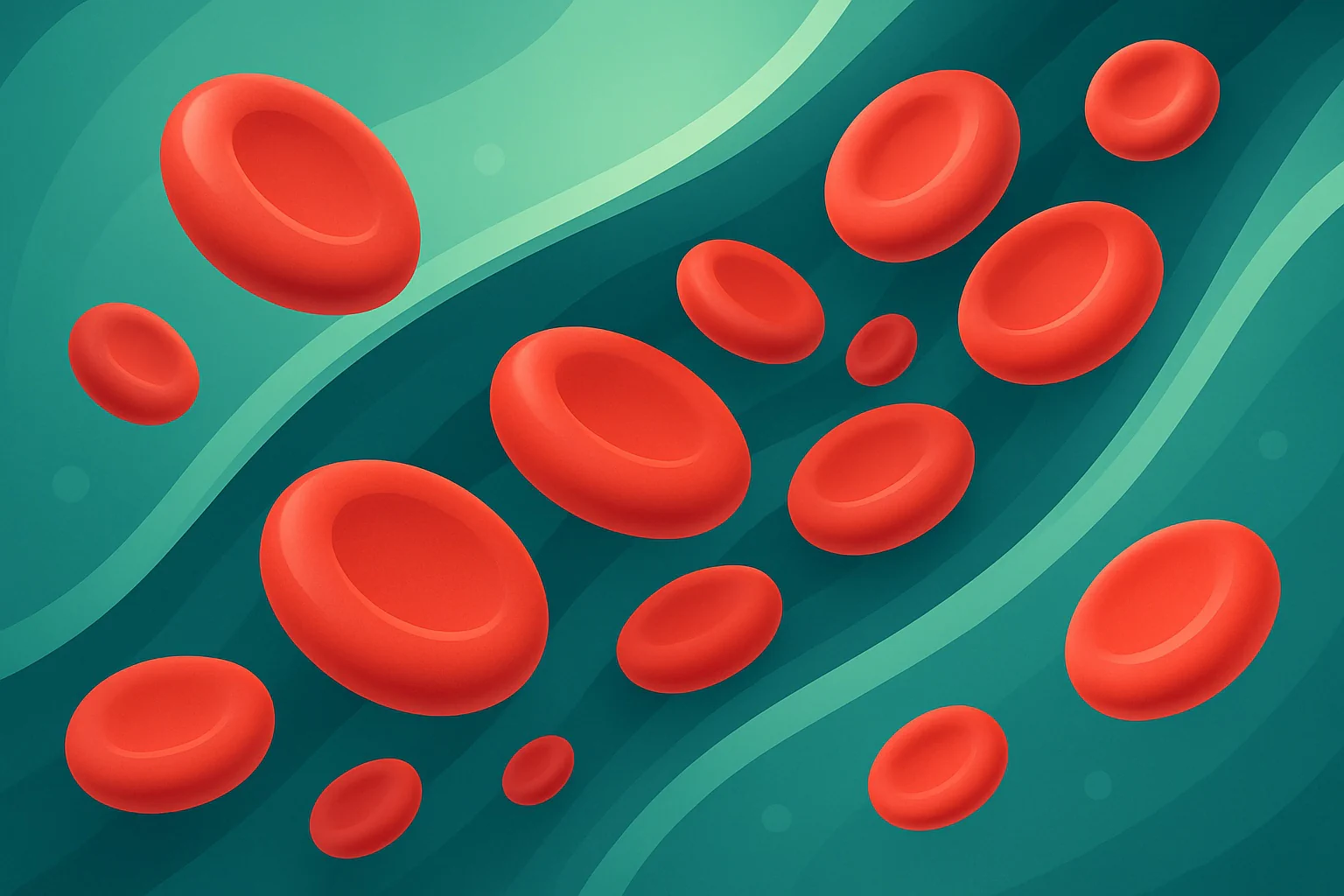
Free hematocrit calculator to estimate Hct from hemoglobin or RBC × MCV. Instant Hct-to-Hgb conversion, normal ranges by age and sex, and visual gauge.
The idea is simple: use a practical hematocrit calculator to turn the numbers you already have—hemoglobin, RBC, and MCV—into a clean Hct estimate, then add plain-English context. The tool stays above the fold; this guide goes deeper so you know what the number means, how the formulas work, and what to consider next.
What is hematocrit (Hct)?
Hematocrit is the fraction of your blood volume occupied by red blood cells, expressed as a percentage. If your Hct is 42%, roughly forty-two percent of the sample volume is packed red cells and the remainder is plasma and a small number of white cells and platelets (interpret those separately with our platelet count calculator). Together with hemoglobin and indices like MCV, hematocrit helps describe oxygen-carrying capacity, hydration status, and certain disease patterns.
Historically, Hct was measured as packed cell volume after centrifugation. Modern analyzers also derive it from RBC and MCV. Either way, the result is reported as a percent, and most labs include a reference interval for the patient's age and sex. It's normal for ranges to differ slightly between labs based on methodology and local population.
How to calculate hematocrit
There are two practical ways to calculate hematocrit from other CBC values. The first is the well-known rule of 3: multiply hemoglobin (in g/dL) by 3 to estimate Hct as a percentage. If your hemoglobin is 14.0 g/dL, then Hct ≈ 14.0 × 3 = 42.0%. This hematocrit calculation is quick, widely taught in clinical training, and reliable when the patient's hydration and cell indices are roughly normal.
The second approach uses red blood cell count and mean corpuscular volume: Hct (%) = RBC (million/µL) × MCV (fL) ÷ 10. This mirrors the method automated analyzers use when deriving Hct. For instance, if RBC = 4.8 and MCV = 90 fL, the hct calculation gives 4.8 × 90 ÷ 10 = 43.2%. Both methods are estimates—the most reliable Hct is the one reported directly by the lab analyzer—but they are valuable for quick mental checks and for sanity-testing an unusual lab printout.
Hct calculation formula explained
Understanding the hct formula helps you interpret your results with confidence. The core equations are:
- 3× Rule (Hb method): Hct (%) = Hemoglobin (g/dL) × 3. This works because each gram of hemoglobin corresponds to roughly 3% of packed cell volume under normal conditions.
- Indices method: Hct (%) = RBC (×10⁶/µL) × MCV (fL) ÷ 10. RBC count tells you how many red cells you have; MCV tells you how big each one is. Multiplying them gives total red cell volume, which is what hematocrit measures.
- Reverse calculation: Hb (g/dL) ≈ Hct (%) ÷ 3. Useful for the hct to hgb conversion when you only have the hematocrit percentage.
The 3× rule can break down in abnormal conditions: large or small red cells (abnormal MCV), dehydration, pregnancy plasma expansion, or certain hemoglobinopathies. When the rule and the analyzer disagree, clinicians trust the analyzer-reported value and investigate the discrepancy.
Typical hematocrit ranges by group
Normal hematocrit levels vary by age, sex, altitude, and lab methodology. Typical adult ranges are about 41–50% for males and 36–44% for females. Children (1–10 years) often fall around 34–42%. During the second and third trimesters of pregnancy, plasma volume expands more than red cell mass, so Hct drifts lower, commonly ~32–42%. If you live at high altitude, your baseline may be higher than sea-level references. Smoking can also raise Hct. The calculator's reference group dropdown provides quick context, but your own lab's interval is the final tie-breaker.
If you're curious how these patterns connect to broader health measures, our blood pressure calculator and oxygen saturation calculator help complete the cardiorespiratory picture you might discuss with your clinician.
Hct to Hgb conversion (hematocrit to hemoglobin)
Converting between hematocrit and hemoglobin is one of the most common reasons people use a hematocrit calculator. The hct to hgb conversion follows a simple formula: divide hematocrit by 3 to get an estimated hemoglobin value in g/dL. For example, an Hct of 39% converts to approximately Hb 13.0 g/dL. The reverse—hemoglobin to hematocrit—simply multiplies Hb by 3.
This conversion is approximate. In clinical practice, the ratio between Hct and Hb (the Hct/Hb ratio) typically ranges from 2.8 to 3.2. When the ratio falls outside this window, it may indicate abnormal cell size, hydration shifts, or measurement artifacts. Our calculator shows both values simultaneously so you can quickly cross-check. For more dedicated hemoglobin analysis, try our hemoglobin calculator.
RBC, MCV, and related indices
The red cell indices bring helpful detail when Hct is off target. MCV describes average red cell size: microcytosis (low MCV) often points toward iron deficiency or thalassemia trait — and dividing MCV by the RBC count with the Mentzer index calculator is the classic screening shortcut for telling those two apart. Macrocytosis (high MCV) may suggest B12 or folate deficiency, alcohol use, or marrow conditions. RDW reflects size variation and tends to rise in nutrient deficiencies. RBC count itself can rise in physiologic adaptations (altitude, endurance training) or certain disorders, and it can fall when marrow production is suppressed or raw materials are lacking.
Because our hematocrit calculator offers the RBC × MCV option, you can "rebuild" Hct from the indices to sanity-check a reported value or to see how a change in cell size would theoretically impact the percentage. Pairing those numbers with a broader wellness view—like hydration targets from our hydration calculator —can make follow-up conversations more concrete.
What raises or lowers hematocrit
Many everyday factors nudge hematocrit. Dehydration concentrates the blood and raises Hct; rehydration does the opposite. Living at altitude and smoking can increase red cell mass and push Hct higher. Pregnancy lowers Hct because plasma volume expands more than RBC mass. Recent blood loss, iron deficiency, chronic disease, and marrow suppression can reduce Hct. Lab factors—tourniquet time, sample handling, analyzer method—also play a role. This is why trend lines and clinical context matter more than a single datapoint.
If you are managing chronic conditions that influence Hct, the surrounding cardiovascular and metabolic context helps. Our eGFR calculator and blood sugar calculator can provide a broader snapshot to discuss at appointments.
Interpreting low hematocrit
Low Hct suggests a relative reduction in red cell mass, an increase in plasma volume, or both. Common reasons include iron deficiency (often with microcytosis), chronic disease, B12 or folate deficiency (often with macrocytosis), kidney disease, bleeding, and marrow disorders. Symptoms can include fatigue, shortness of breath with activity, palpitations, headache, or dizziness. However, many people have mild changes without symptoms. Clinicians look for patterns—MCV, RDW, reticulocyte count, ferritin, B12—and compare with prior values.
If your result is unexpectedly low, consider timing (illness, dehydration, strenuous exercise, or menstruation), repeat the test when you feel well, and bring both values to your clinician. The hematocrit calculator can't diagnose, but it can help you articulate the size of the change and where it sits relative to typical ranges.
If iron deficiency has been established, use laboratory hemoglobin rather than the hematocrit percentage in the iron deficit calculator. Its Ganzoni calculation separates the iron needed for a selected Hb increase from the allowance for iron stores.
Interpreting high hematocrit
High Hct can reflect dehydration, altitude adaptation, chronic lung disease, sleep-disordered breathing, smoking, or a primary marrow process that increases red cell production. Some medications or testosterone therapy may also raise Hct. Symptoms vary and can include headache, flushing, or fatigue. If Hct is sharply elevated or rising over time, your clinician may repeat testing after hydration, investigate oxygenation, and check erythropoietin levels or marrow signals as needed.
Worked examples: how to calculate hematocrit step by step
Example 1 — From hemoglobin: Suppose your hemoglobin is 14.2 g/dL. Using the 3× rule, hematocrit ≈ 3 × 14.2 = 42.6%. On our calculator, select "From Hemoglobin," enter 14.2, and you'll see ~42.6% with a Normal tag for most adult reference groups. The tool also shows the inverse estimate automatically (Hb ≈ Hct ÷ 3) so you can check your mental math.
Example 2 — From RBC × MCV: Say your RBC is 4.8 million/µL and MCV is 88 fL. The hct calculation is: Hct (%) = 4.8 × 88 ÷ 10 = 42.24%, or ~42.2%. Enter 4.8 and 88 under "From RBC × MCV," and compare the classification. If you change MCV to 76 fL (a microcytic shift), the Hct estimate drops to ~36.5%—a reminder that cell size and iron status can shape the percentage even when RBC count is similar.
Example 3 — Pregnancy context: If a pregnant adult has Hb 11.3 g/dL in the second trimester, the 3× rule yields ~33.9%. Selecting the pregnancy reference group will show this near the lower edge of the typical interval. Clinicians also review symptoms, iron studies, and prior values before deciding on next steps.
Example 4 — Hct to Hgb conversion: Your lab reports Hct = 48% but you want to know the approximate hemoglobin. The hct to hgb conversion is Hb ≈ 48 ÷ 3 = 16.0 g/dL. This is within the typical male range. If the lab also reports the actual Hb and it differs significantly from 16.0, that discrepancy may signal abnormal cell size or hydration status worth discussing with your provider.
Quality and sampling caveats
Small pre-analytic details can nudge results. A tight tourniquet for too long, fist pumping, or delayed processing may subtly concentrate a sample. Laboratory analyzers apply their own calibration and algorithms when deriving Hct from indices; switching laboratories can introduce small shifts that reflect method differences rather than true physiology. If a result feels out of character, repeating it under routine conditions (usual hydration, no illness, typical activity) improves reliability.
Device type matters, too. Point-of-care meters and capillary samples can diverge from venous analyzer values. When trends drive decisions—like evaluating anemia therapy—clinicians prefer consistent methods and venues so that movement in the number represents your biology rather than noise.
Using this hematocrit calculator well
Start with the method that matches what you have on hand. If your report shows only hemoglobin, the 3× rule gives you a fast approximation. If you have RBC and MCV, the RBC × MCV ÷ 10 route offers a tidy cross-check. Select the most appropriate reference group—adult male, adult female, pregnancy (2nd/3rd), or child—and read the short interpretation for context. You can copy the summary to your notes and compare with the next result to see the size and direction of change.
Remember, numbers live inside stories. Hydration, sleep, altitude, training, diet, and chronic conditions all shape hematocrit. This tool is optimized for clarity and speed; diagnosis and treatment belong with your healthcare professional.
Planning follow-up and next steps
If today's estimate differs from your usual pattern, consider a simple plan: repeat the test when you feel well and hydrated, compare the two values, and bring both to your appointment. Think about symptoms (fatigue, breathlessness, dizziness), recent changes (illness, training, altitude travel), and diet (iron, B12, folate). For a broader context, many clinicians review blood pressure, glucose, and kidney function alongside CBC trends. Our tools can help organize those pieces so the conversation is concrete and efficient.
Helpful related calculators
- Hemoglobin calculator — estimate Hb and explore related conversions.
- Oxygen saturation — a complementary view of oxygen delivery.
- Hydration calculator — dehydration and overhydration can shift Hct.
- Blood pressure — cardiovascular context often travels with CBC patterns.
- eGFR (CKD-EPI) — kidney health and erythropoietin signaling can influence red cell production.
References and further reading
Patient-friendly, authoritative resources:
This article is informational and does not provide medical advice. Always review unexpected or persistent results with your clinician.

Written by Marko Šinko
Co-Founder & Lead Developer
Computer scientist and developer working on calculator implementation, data handling, and accessible interfaces. His authorship describes development work, not independent medical review.
View full profileFrequently Asked Questions
What does the hematocrit calculator measure?
It estimates hematocrit (Hct)—the percent of blood volume made up of red blood cells—using either the 3× hemoglobin rule or the RBC × MCV ÷ 10 equation.
How do you calculate hematocrit from hemoglobin?
Multiply hemoglobin (in g/dL) by 3. For example, if Hb is 14.0 g/dL, hematocrit ≈ 14.0 × 3 = 42.0%. This is the well-known rule of 3 used in clinical settings.
What is the hct calculation formula using RBC and MCV?
Hct (%) = RBC (million/µL) × MCV (fL) ÷ 10. For example, RBC 4.8 × MCV 90 ÷ 10 = 43.2%. This mirrors how automated blood analyzers derive hematocrit from indices.
How do I convert hct to hgb?
Divide hematocrit by 3 to estimate hemoglobin in g/dL. For example, Hct 45% ÷ 3 ≈ Hb 15.0 g/dL. This hct to hgb conversion is approximate; the actual ratio ranges from about 2.8 to 3.2.
What is a normal hematocrit level?
Typical adult ranges are ~41–50% for males and ~36–44% for females. Pregnancy (2nd/3rd trimester) runs lower (~32–42%). Children ages 1–10 are typically 34–42%. Labs and methods vary.
Can hydration or altitude change Hct?
Yes. Dehydration can raise Hct; higher altitudes and smoking can also increase it. Overhydration or blood loss may lower it. Always consider context.
Do you store my values?
No. Calculations run only in your browser. We do not store or transmit personal data.
When should I talk to a clinician about results from this hematocrit calculator?
If results are unexpected, persistently low or high, or you have symptoms (fatigue, shortness of breath, dizziness), discuss them with a healthcare professional.
Related Calculators
A1C Calculator — Convert HbA1c to eAG with Targets
Use our A1C calculator to convert HbA1c to estimated average glucose (eAG). See normal, prediabetes, and diabetes thresholds in mg/dL and mmol/L. Fast results.

Albumin Calculator — Serum Albumin Level Interpretation
Free albumin calculator to interpret serum albumin levels, grade hypoalbuminemia, and compute A/G ratio plus albumin-corrected calcium from your lab results.
Albumin-Corrected Anion Gap Calculator — Hidden Acidosis
Use our albumin-corrected anion gap calculator to raise the anion gap by 2.5 per 1 g/dL of low albumin and reveal a hidden high-gap metabolic acidosis.

ANC Calculator: Absolute Neutrophil Count & Neutropenia
Free ANC calculator to calculate absolute neutrophil count from WBC and differential. Get ANC in cells/uL and x10^9/L with instant neutropenia grading.
Anion Gap Calculator — Metabolic Acidosis Evaluation
Free anion gap calculator finds serum anion gap from sodium, chloride, and bicarbonate, with albumin correction and delta ratio for metabolic acidosis.
AST/ALT Ratio Calculator — Free De Ritis Ratio Tool
Use our free AST/ALT ratio calculator to compute the De Ritis index instantly. Visual ratio chart, enzyme-level assessment, and clinical patterns guide.