Calculate your plan — Weight Loss Calorie Calculator
Target intake
1,729 kcal/day
Sex
Units
Plan by
Target daily intake
1,729kcal/day
BMR
1,470
kcal/day
TDEE (maintain)
2,279
kcal/day
Daily deficit
550
kcal/day
Weekly loss
0.5 kg
per week
Estimated daily macros (30/35/35 split)
130g
Protein
151g
Carbs
67g
Fat
Timeline to goal
Estimated time
20 weeks
Rough goal date
Feb 3, 2027
Weight changes are not perfectly linear; focus on weekly trends.
Common calorie deficit scenarios
| Intensity | Deficit | kg/wk |
|---|---|---|
| Very mild | 250 kcal/day | ~0.23 |
| Mild | 500 kcal/day | ~0.45 |
| Moderate | 750 kcal/day | ~0.68 |
| Aggressive | 1000 kcal/day | ~0.91 |
Disclaimer: This weight loss calorie calculator provides educational estimates only. Individual needs vary with body composition, medications, and health conditions. Results are not medical advice. If you have health concerns or plan a large deficit, consult a qualified healthcare provider or registered dietitian.
Educational tool, not medical advice. Check this tool’s method and limitations before interpreting a result. Talk to a qualified healthcare professional before making decisions about medication, diet, exercise, or treatment. See our Terms of Use.
Your rating helps improve Weight Loss Calorie Calculator — Deficit Planner. We store only an anonymized vote (no personal data).
How to Use Weight Loss Calorie Calculator — Deficit Planner
Step 1: Set sex and units
Choose male or female and pick Metric (kg, cm) or US (lb, ft/in). Your entries will match your choice.
Step 2: Enter age, height, weight
Type your age in years, height, and current body weight. BMR, TDEE, and results update instantly.
Step 3: Select activity level
Pick the option that best matches your typical week to estimate TDEE (maintenance calories).
Step 4: Choose loss pace or deficit
Use Weekly loss or Daily deficit mode. Pick a preset chip or type your own value to see your target intake, macros, and deficit intensity.
Step 5: Add goal weight (optional)
Enter a goal weight to see an estimated timeline in weeks and a rough goal date.
Step 6: Copy or reset
Tap Copy Summary to save your full plan, including macros and timeline. Use Reset to start a new calculation.
Key Features
- Calorie deficit from BMR and TDEE
- Mifflin–St Jeor equation with activity
- Weekly loss pace or daily deficit mode
- Goal weight timeline and date estimate
- Estimated daily macro breakdown
- Metric and US unit support
Understanding Results
How the Calorie Deficit Is Calculated
The calculator estimates your Basal Metabolic Rate (BMR) with the Mifflin–St Jeor equation, then multiplies by an activity factor to get your Total Daily Energy Expenditure (TDEE). Your calorie deficit is set directly or derived from your weekly loss pace using ~3,500 kcal per lb or ~7,700 kcal per kg.
- BMR (Mifflin–St Jeor): male = 10×kg + 6.25×cm − 5×age + 5; female = 10×kg + 6.25×cm − 5×age − 161
- TDEE ≈ BMR × activity factor (1.2 sedentary → 1.9 extra active)
- Calorie deficit from weekly loss: lb/week × 3,500 ÷ 7, or kg/week × 7,700 ÷ 7
- Target intake ≈ TDEE − daily calorie deficit
- Macros ≈ 30% protein, 35% carbs, 35% fat (adjustable in our Macro Calculator)
Interpreting Your Calorie Deficit Results
A calorie deficit for weight loss means eating fewer calories than you burn. A steady deficit of 250–500 kcal/day is often the sweet spot: enough to lose 0.25–0.5 kg (0.5–1 lb) per week while preserving energy and training quality. The deficit intensity gauge shows whether your plan is mild, moderate, or aggressive relative to your TDEE.
The estimated daily macros give a starting breakdown for protein, carbs, and fat. Higher protein helps preserve muscle during a calorie deficit. If you enter a goal weight, the timeline section estimates weeks and a rough goal date from your chosen pace.
If the target intake drops close to your BMR or the intensity gauge shows “aggressive,” consider reducing the pace or increasing activity. Many adults should avoid sustained intakes below 1,200 kcal (women) or 1,500 kcal (men). When unsure, seek professional advice.
Assumptions & Limitations
These are estimates based on population averages. Hydration, sleep, medications, hormones, and body composition can shift energy needs by 10% or more. Daily weight can fluctuate by 1–2 kg due to water and glycogen; focus on weekly trends. This tool is informational and not medical advice.
Complete Guide: Weight Loss Calorie Calculator — Deficit Planner

On this page
A weight loss calorie calculator helps you estimate a safe daily calorie deficit so you can lose weight at a sustainable pace without guesswork. Instead of following a generic 1,200 or 2,000 calorie plan, this tool personalizes the number to your age, sex, height, current weight, and activity level—then shows exactly how many calories to eat each day and how long it will take to reach your goal weight.
For quick reference, many people also compare results with our Calorie Calculator, check their basal energy with the BMR Calculator, or estimate maintenance calories using the TDEE Calculator. If you want to turn your calorie target into food choices, try the Macro Calculator and the Protein Calculator.
How the weight loss calorie calculator works
The calculator follows a three-step flow. First, it estimates your Basal Metabolic Rate (BMR) using the Mifflin–St Jeor equation—the most widely validated formula for predicting resting energy expenditure in healthy adults (Mifflin et al., 1990). Second, it multiplies BMR by an activity factor (1.2–1.9) that reflects how much you move in a typical week. That product is your estimated Total Daily Energy Expenditure (TDEE), also called maintenance calories.
Finally, the calculator subtracts a daily calorie deficit to produce a target daily intake. If you prefer thinking in weekly weight loss instead of calories, switch to “weekly pace” mode. The tool converts pace to a calorie deficit using the widely used energy equivalents: about 3,500 kcal per pound or 7,700 kcal per kilogram of body weight (Hall et al., 2011).
All calorie estimates are approximations. Two people of the same size can have different needs due to body composition, hormones, sleep, medication, or daily movement. Use the numbers as a starting point, then adjust based on your weekly weight trend.
How to choose a safe calorie deficit for weight loss
A calorie deficit of 250–500 kcal per day is the most common recommendation for sustainable weight loss. At a 500 kcal/day deficit, you can expect to lose roughly 0.45 kg (1 lb) per week. At 250 kcal/day, the pace is about half a pound per week—slower, but easier to maintain without hunger or fatigue.
Research from the National Institutes of Health suggests that deficits larger than 1,000 kcal/day often lead to muscle loss, nutrient deficiencies, and metabolic adaptation that can stall progress within weeks. If your target intake drops close to your BMR—or below 1,200 kcal for women or 1,500 kcal for men—the plan may be too aggressive.
A balanced plan fits your schedule, budget, and social life. If the numbers look too strict on paper, they will be even harder in practice. Pick the smallest change that still moves you forward.
Weekly loss pace vs. daily calorie deficit—which should you pick?
Some people prefer to think in calories; others find it easier to target a weekly pace like “about one pound per week.” Both approaches are valid because they convert directly into each other. A 500 kcal/day deficit equals roughly 1 lb/week; a 0.5 kg/week pace equals about 550 kcal/day.
If you are unsure, try a modest pace (0.25–0.5 kg/week or 0.5–1.0 lb/week) for two to three weeks and observe your average trend. If you are losing faster than expected and feeling low energy, increase calories by 100–150 kcal. If progress is much slower, tighten the deficit slightly or add more walking.
Worked example: calculating a calorie deficit to lose weight
Person: 35-year-old woman, 165 cm tall, 75 kg, moderately active (3–5 days of exercise per week).
| Step | Calculation | Result |
|---|---|---|
| 1. BMR (Mifflin–St Jeor) | 10 × 75 + 6.25 × 165 − 5 × 35 − 161 | 1,420 kcal/day |
| 2. TDEE | 1,420 × 1.55 (moderately active) | 2,201 kcal/day |
| 3. Choose deficit | Target: 0.5 kg/week → 550 kcal/day | 550 kcal deficit |
| 4. Target intake | 2,201 − 550 | 1,651 kcal/day |
| 5. Timeline to 65 kg | (75 − 65) / 0.5 kg per week | ~20 weeks |
She checks her trend every two weeks and adjusts by 100–150 kcal if needed. At 20 weeks (~5 months), the weight loss timeline is realistic for a 10 kg loss without extreme restriction. If she hits a plateau around week 8–10, recalculating with her new weight will keep the deficit accurate.
What a realistic timeline to your goal weight looks like
When you enter a goal weight, the calculator estimates how many weeks your current pace would take and shows a rough calendar date. Weight does not drop in a straight line—water and glycogen changes can hide fat loss for days or move the scale more than expected after a salty meal. Expect fluctuations of 1–2 kg (2–4 lb) day to day even when you are on track.
Pair this tool with our Weight Loss Date Calculator for a second perspective. If your goal is far away, tracking percentage change with the Weight Loss Percentage Calculator keeps you motivated even when the absolute number feels slow.
Protein, carbs, and fats: turning calories into meals
Calories tell you “how much,” but macros tell you “from what.” A higher protein intake (1.6–2.2 g/kg of body weight per day) supports satiety and helps preserve lean mass during weight loss. In the worked example above, at 1,651 kcal/day the macro split might be roughly 124 g protein, 144 g carbs, and 64 g fat—enough to stay full and fuel moderate exercise.
For a personalized breakdown, use the Macro Calculator and confirm your protein target with the Protein Calculator. If you are curious about body composition changes beyond the scale, the Body Fat Percentage Calculator can help.
Hunger on 1,651 kcal depends less on the macro split than on how much that food weighs. Swap a 340 g granola‑and‑whole‑milk breakfast (577 kcal) for the same 340 g as oatmeal with skim milk (204 kcal) and you free up 373 kcal without touching portion size. The calorie density calculator ranks foods by calories per gram so you can find those swaps deliberately instead of by trial and error.
The activity factor: steps, strength, and daily movement
The activity level you select calibrates your maintenance estimate. A person classified as “sedentary” (factor 1.2) burns roughly 40% fewer total calories than someone “very active” (factor 1.725). That difference can be 800+ kcal/day for a 80 kg adult. When in doubt, choose the lower option and adjust with real-world data.
Non-exercise activity (walking to the store, taking stairs, standing regularly) can add 200–400 calories per day. Increasing gentle movement is often easier than cutting an extra 200 calories from food—you eat a bit more and still move toward your goal.
Plateaus, water weight, and what to do when the scale stalls
Short plateaus are normal. Weight can stay flat for 1–2 weeks even in a true calorie deficit. Sodium intake, menstrual cycles, sore muscles from a new workout, and travel can all shift water weight by 1–3 kg overnight. Give your plan two to three weeks before making changes, and focus on the weekly average, not the lowest daily weigh-in.
If progress stalls for three or more weeks, recheck your inputs, log more carefully for a few days, or increase movement. Confirm your baseline using the TDEE Calculator or compare against the general targets from the Calorie Calculator.
Common mistakes when calculating a calorie deficit
Avoid these four pitfalls that derail most calorie deficit plans:
- Choosing too large a deficit. A 1,000+ kcal/day deficit sounds fast, but often leads to muscle loss, intense hunger, and a 60–70% higher dropout rate within 12 weeks (Franz et al., 2007).
- Ignoring protein. Eating below 1.2 g/kg of protein during a deficit accelerates lean mass loss, which lowers BMR and makes further weight loss harder.
- Never recalculating. After losing 5+ kg, your TDEE drops by roughly 50–80 kcal. Without adjusting, the deficit shrinks and progress stalls.
- Reacting to daily weight swings. A single high weigh-in after a restaurant meal means water and food volume, not fat gain. Always compare weekly averages.
Tracking progress and when to recalculate
Weigh under similar conditions (morning, after using the bathroom) and focus on weekly averages. Recalculate after meaningful changes in weight (every 3–5 kg lost) or routine so your TDEE estimate and calorie deficit stay aligned with your current status.
If you are curious about your BMI category as you lose weight, check it with the Adult BMI Calculator. BMI is a general indicator and does not directly measure body fat or health, but it provides useful context alongside your calorie deficit progress.
When to seek professional guidance
This weight loss calorie calculator is for educational use. If you have a medical condition, take medications affecting appetite or fluid balance, are pregnant or breastfeeding, or have a history of disordered eating, talk with a qualified professional before starting a calorie deficit. They can create a plan that fits your individual needs.
Focus on habits you can repeat most days and use the numbers as a guide. Small, steady calorie deficits compound into lasting results.
References
- Mifflin MD, St Jeor ST, Hill LA, et al. A new predictive equation for resting energy expenditure in healthy individuals. Am J Clin Nutr. 1990;51(2):241-247.
- Hall KD, Heymsfield SB, Kemnitz JW, et al. Energy balance and its components: implications for body weight regulation. Am J Clin Nutr. 2012;95(4):989-994.
- Franz MJ, VanWormer JJ, Crain AL, et al. Weight-loss outcomes: a systematic review and meta-analysis of weight-loss clinical trials with a minimum 1-year follow-up. J Am Diet Assoc. 2007;107(10):1755-1767.
- National Institutes of Health. Calorie reduction and physical activity for weight management. NIH Clinical Guidelines.
- CDC — Losing Weight. Centers for Disease Control and Prevention. Healthy Weight, Nutrition, and Physical Activity.
- Dietary Guidelines for Americans, 2020–2025. U.S. Department of Agriculture and U.S. Department of Health and Human Services.

Written by Jurica Šinko
Founder & CEO
Entrepreneur and health information advocate, passionate about making health calculations accessible to everyone through intuitive digital tools.
View full profileFrequently Asked Questions
How do I calculate a calorie deficit to lose weight?
First estimate your maintenance calories (TDEE) from BMR and activity level. Then subtract 250 to 500 kcal per day to create a deficit. A 500 kcal daily deficit produces roughly 1 pound (0.45 kg) of weight loss per week.
What does the weight loss calorie calculator show?
It estimates your BMR, TDEE, a safe daily calorie deficit, target intake, estimated macros, weekly loss pace, and a timeline to your goal weight. Results update instantly as you type.
How big should my calorie deficit be for safe weight loss?
Most adults do well with 250 to 500 kcal per day below TDEE. This yields about 0.25 to 0.5 kg (0.5 to 1 lb) per week. Deficits over 1,000 kcal per day often cause muscle loss and are hard to sustain.
Should I set a weekly loss pace or a daily calorie deficit?
Either works because they convert into each other. A pace of 1 lb per week equals roughly a 500 kcal daily deficit (3,500 kcal per lb per week). Pick whichever method is easier for you to follow consistently.
Is the Mifflin-St Jeor equation accurate?
It is one of the most validated BMR equations for healthy adults, accurate to within about 10 percent for most people. Body composition, hormones, sleep, and medications can shift individual needs above or below the estimate.
How long will it take to reach my goal weight?
Enter a goal weight and choose a weekly pace. The calculator estimates weeks and a rough date. At 0.5 kg per week, losing 10 kg takes about 20 weeks. Treat timelines as guides because weight loss is not perfectly linear.
When should I recalculate my calorie deficit?
Recalculate after every 3 to 5 kg lost or when your activity level changes. As you lose weight your BMR drops by roughly 50 to 80 kcal, so your deficit shrinks unless you adjust.
Do you store my data?
No. All calculations run in your browser and nothing is saved or sent to a server. You can use the Copy Summary button to save your results for personal reference.
Related Calculators
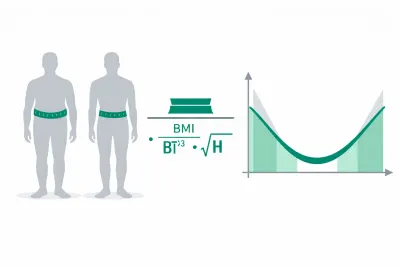
ABSI Calculator: A Body Shape Index & Mortality Risk
Free ABSI calculator computes A Body Shape Index from waist, height, and BMI to estimate visceral fat and mortality risk independent of body mass index.

Adult BMI Calculator for Men & Women — WHO BMI Guide
Use the adult BMI calculator to find your BMI with WHO categories. Enter metric or imperial units to see your status and BMI ranges quickly and clearly.

Army Body Fat Calculator — AR 600‑9 Standard Compliance
Check compliance with the Army body fat calculator per AR 600-9 standards. Enter circumference measures by sex to estimate body fat % and see pass/fail status.
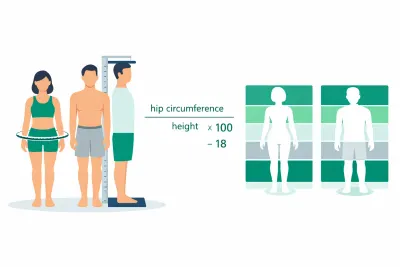
Body Adiposity Index Calculator (BAI) — Body Fat %
Free body adiposity index calculator estimates body fat percentage from hip circumference and height using the BAI formula, no weight or scale needed.
Body Composition Calculator — Fat, Lean Mass Breakdown
Use our body composition calculator to estimate body fat percentage, fat mass, and lean mass from tape measurements. Switch units and get clear categories.

Body Fat Calculator — Percentage for Men & Women (Tape)
Estimate with the body fat percentage calculator (body fat calculator) using Navy circumference equations. Supports metric/imperial and sex‑specific inputs.