Your BMI
32.9
Sex
Adults 20+. Not medical advice.
Your Body Mass Index
Healthy range for your height
53.5 – 72.0 kg
8.6 kg to leave obesity
Obesity classes by BMI — weight ranges for your height
| Category | BMI range | Weight |
|---|---|---|
| Underweight | < 18.5 | < 53.5 kg |
| Healthy | 18.5 – 24.9 | 53.5 kg – 72.0 kg |
| Overweight | 25.0 – 29.9 | 72.2 kg – 86.4 kg |
| Class I ◄ | 30.0 – 34.9 | 86.7 kg – 100.9 kg |
| Class II | 35.0 – 39.9 | 101.1 kg – 115.3 kg |
| Class III | ≥ 40.0 | ≥ 115.6 kg |
Est. body fat
42.1%
Deurenberg formula
Waist-to-height
—
Enter waist to calculate
BMR
1,677 kcal
Mifflin-St Jeor
Maintenance (TDEE)
2,599 kcal
Based on activity
Estimated path to healthy BMI (24.9)
47
weeks
23.0
kg to lose
550
kcal deficit/day
2,049
target kcal/day
BMI is a screening tool, not a diagnosis. It does not measure body fat directly and may misclassify muscular individuals. Consult a healthcare provider for personalized advice. WHO obesity classes: I (30–34.9), II (35–39.9), III (40+).
Educational tool, not medical advice. Check this tool’s method and limitations before interpreting a result. Talk to a qualified healthcare professional before making decisions about medication, diet, exercise, or treatment. See our Terms of Use.
Your rating helps improve Obesity Calculator — BMI Obesity Classes 1, 2, 3. We store only an anonymized vote (no personal data).
How to Use Obesity Calculator — BMI Obesity Classes 1, 2, 3
Step 1: Select your unit system
Toggle between Metric (cm, kg) and US (ft/in, lb) at the top of the obesity calculator.
Step 2: Enter height and weight
Type your height and weight. Your BMI value and obesity class (1, 2, or 3) appear instantly in the results panel.
Step 3: Add sex, age, and waist
Choose your sex and enter age for a body-fat estimate. Add waist circumference to calculate your waist-to-height ratio.
Step 4: Review your obesity class table
Check the personalized weight ranges table to see the exact weights for each BMI class at your height.
Step 5: Set activity level and weight loss pace
Pick your activity level for TDEE calories, then adjust the pace slider to preview how many weeks to reach BMI 24.9.
Step 6: Copy or share your results
Use the Copy Results button to save your BMI, obesity class, calorie targets, and timeline.
Key Features
- BMI with obesity class I, II, III (WHO cutoffs)
- Personalized weight ranges per obesity class for your height
- Waist-to-height ratio for central adiposity screening
- Body fat estimate (Deurenberg formula)
- BMR and TDEE calorie estimates
- Weight loss timeline with calorie deficit plan
Understanding Your Obesity Class Results
BMI Formula
BMI = weight (kg) ÷ [height (m)]². In US units: BMI = 703 × weight (lb) ÷ [height (in)]². The obesity calculator converts all inputs to the metric formula and rounds to one decimal. Your obesity class is assigned using WHO cutoffs: class 1 starts at BMI 30.0, class 2 at 35.0, and class 3 at 40.0.
Obesity Classes by BMI — Reference Ranges
The WHO defines six BMI categories for adults aged 20+: Underweight (<18.5), Healthy weight (18.5–24.9), Overweight (25.0–29.9), Obesity class 1 (30.0–34.9), Obesity class 2 (35.0–39.9), and Obesity class 3 (≥40.0). The calculator also shows a personalized healthy weight range and the maximum weight to stay below the obesity threshold (BMI <30) for your height.
Waist-to-height ratio adds important context: values above 0.5 suggest increased central adiposity, which carries cardiovascular and metabolic risk beyond what BMI alone captures. See guidance from the CDC and the WHO.
Assumptions & Limitations
BMI and WHtR are screening tools, not diagnoses. They do not directly measure body fat and can misclassify muscular individuals. These obesity class cutoffs apply to adults — children and adolescents use age-specific percentiles instead. Pregnancy and certain medical conditions also affect interpretation.
Treat your obesity class as a starting point. Losing 5–10% of body weight often improves blood pressure, cholesterol, and blood sugar regardless of which class you start in. Focus on sustainable habits — balanced meals, daily movement, strength training, and consistent sleep.
For a complete overview of BMI categories and alternatives, read our comprehensive BMI guide.
Complete Guide: Obesity Classes by BMI

On this page
An obesity calculator turns your height and weight into a BMI value, then maps it to one of the three WHO obesity classes so you know exactly where you stand. Over 650 million adults worldwide live with obesity, yet many are unsure whether they fall into class 1, class 2, or class 3 — and each class carries different health implications. This guide explains the obesity classes by BMI, shows you the weight ranges for every class at common heights, and outlines a realistic plan to move toward a healthier BMI.
What is obesity and how is it classified?
Obesity is defined as a BMI of 30.0 or higher. The World Health Organization further divides obesity into three classes to reflect increasing severity and health risk. Class 1 obesity (BMI 30.0–34.9) is sometimes called moderate obesity and often responds well to lifestyle changes alone. Class 2 (BMI 35.0–39.9) is severe obesity, where structured programs and sometimes medical support become more important. Class 3 (BMI 40.0 or higher), also known as morbid or very severe obesity, typically benefits from a multidisciplinary approach including clinical oversight.
These BMI obesity classes correlate with population-level risk for type 2 diabetes, cardiovascular disease, sleep apnea, and certain cancers. However, BMI alone does not capture the full picture — it does not distinguish fat from muscle, nor does it tell you where fat is stored. That is why the calculator also includes waist-to-height ratio and estimated body fat for additional context.
Obesity classes 1, 2, 3 by BMI — reference table
The table below summarizes all WHO BMI categories, including the three obesity classes. These cutoffs apply to adults aged 20 and older, regardless of sex.
| Category | BMI range | Risk level |
|---|---|---|
| Underweight | < 18.5 | Increased (nutritional) |
| Healthy weight | 18.5 – 24.9 | Normal |
| Overweight | 25.0 – 29.9 | Mildly increased |
| Obesity class 1 | 30.0 – 34.9 | Moderate |
| Obesity class 2 | 35.0 – 39.9 | Severe |
| Obesity class 3 | ≥ 40.0 | Very severe |
A BMI of exactly 30.0 enters obesity class 1, while 35.0 marks the start of class 2, and 40.0 marks class 3. Some clinical guidelines use additional sub-categories (e.g., super obesity at BMI 50+), but the three-class system above is the most widely used. For a quick check without the obesity class detail, try our adult BMI calculator.
How the obesity calculator works
Enter your height and weight in metric or US units. The calculator converts everything to metric internally and applies the standard BMI formula: BMI = weight (kg) ÷ height (m)². It then assigns the appropriate obesity class using the WHO cutoffs above. If you provide your sex and age, it estimates body fat with the Deurenberg equation. Adding a waist measurement yields your waist-to-height ratio (WHtR) for central adiposity screening.
Worked example: A 35-year-old woman who is 170 cm tall and weighs 95 kg has a BMI of 95 ÷ (1.70 × 1.70) = 32.9, placing her in obesity class 1. Her estimated body fat is (1.20 × 32.9) + (0.23 × 35) − (10.8 × 0) − 5.4 = 41.1%. Using the Mifflin-St Jeor equation with moderate activity, her TDEE is approximately 2,165 kcal/day. At a pace of 0.5 kg/week she could reach BMI 24.9 (71.9 kg) in about 46 weeks.
What weight is each BMI class at common heights?
Many people search for the exact weight that corresponds to each obesity class for their height. The table below answers questions like “what BMI is class 1 obesity at 5'6?” or “how many pounds is class 3 obesity?” For a precise answer for your exact height, enter it in the calculator above.
| Height | Healthy max | Class 1 starts | Class 2 starts | Class 3 starts |
|---|---|---|---|---|
| 5'0" (152 cm) | 128 lb / 58 kg | 153 lb / 69 kg | 179 lb / 81 kg | 204 lb / 92 kg |
| 5'4" (163 cm) | 145 lb / 66 kg | 174 lb / 79 kg | 204 lb / 92 kg | 232 lb / 105 kg |
| 5'7" (170 cm) | 159 lb / 72 kg | 191 lb / 87 kg | 223 lb / 101 kg | 255 lb / 116 kg |
| 5'10" (178 cm) | 174 lb / 79 kg | 209 lb / 95 kg | 243 lb / 110 kg | 278 lb / 126 kg |
| 6'0" (183 cm) | 184 lb / 83 kg | 221 lb / 100 kg | 258 lb / 117 kg | 295 lb / 134 kg |
| 6'3" (191 cm) | 200 lb / 91 kg | 240 lb / 109 kg | 280 lb / 127 kg | 320 lb / 145 kg |
Values are rounded to the nearest pound/kilogram. The “starts” column shows the minimum weight for that obesity class at the given height. For your specific height and exact thresholds, the calculator generates a personalized table.
Waist-to-height ratio and central adiposity
Central adiposity — carrying more fat around the abdomen — is associated with higher metabolic and cardiovascular risk even at similar BMI values. The waist-to-height ratio (WHtR) divides your waist circumference by your height. For most adults, a ratio under 0.5 is considered healthy; above 0.5 suggests increased central fat, and above 0.6 indicates high risk. WHtR is not a diagnosis, but it adds important nuance beyond what BMI classes alone can tell you.
To measure correctly, relax your abdomen, stand tall, and wrap a tape measure around the narrowest area between the bottom of your ribs and the top of your hip bones. Keep the tape snug but not compressing the skin. For a dedicated analysis, try the waist-to-height ratio calculator.
Body fat estimates and their limits
The calculator includes an estimated body-fat percentage based on the Deurenberg equation, which uses BMI, age, and sex. This is a population-level estimate and can vary depending on muscularity, hydration, ethnicity, and fat distribution. Typical healthy body fat ranges are 10–20% for men and 18–28% for women, though these shift with age. For a more detailed analysis using multiple methods, see our body fat percentage calculator.
When comparing methods (bioimpedance scales, calipers, circumference formulas), expect different readings. Use the same method over time under similar conditions — morning, similar hydration, after using the restroom — to focus on trend rather than absolute precision.
How to move from obesity class 3 to class 1 and beyond
Moving between obesity classes is entirely achievable with consistent effort. The first milestone many people target is getting below BMI 30 — the boundary between obesity class 1 and overweight. The calculator shows the maximum weight at your height to be below that threshold, and a sustained loss of 5–10% of starting weight often improves blood pressure, blood lipids, and glucose control even before reaching overweight.
The pace slider previews timelines. A common sustainable range is 0.25–0.75 kg (0.5–1.5 lb) per week. Faster is not automatically better — consistency wins. Use our weight loss calorie calculator and calorie calculator to align intake with your goal pace.
- Class 3 to class 2: Requires dropping below BMI 40. At 170 cm, that means going from 116+ kg to under 116 kg. Focus on a 300–500 kcal daily deficit and 150+ minutes of weekly movement.
- Class 2 to class 1: Requires dropping below BMI 35. At 170 cm, that means reaching under 101 kg. By this point many people have established solid habits and can add strength training.
- Class 1 to overweight: Requires dropping below BMI 30 (under 87 kg at 170 cm). This milestone often coincides with visible improvements in energy, mobility, and lab markers.
- Overweight to healthy: Requires BMI under 25 (under 72 kg at 170 cm). Use the overweight calculator to track this final stretch.
Calories, protein, activity, and sleep
Weight change happens when average intake sits below or above average expenditure over time. The calculator gives you BMR (basal metabolic rate) and TDEE (total daily energy expenditure) to set a realistic calorie target. For a deeper dive, pair this with the BMR calculator and TDEE calculator.
- Protein: Aim for 1.6–2.2 g/kg/day to support muscle retention during weight loss.
- Produce: Center meals on vegetables and fruit for bulk and micronutrients with fewer calories.
- Strength: 2–3 sessions per week preserves muscle and improves metabolic health.
- Steps: Raise daily movement with walks, stairs, and activities you enjoy.
- Sleep: Guard a 7–9 hour window — consistent bedtime helps manage appetite hormones.
You can sense-check your targets using the ideal body weight calculator and healthy weight range calculator.
Common mistakes when using BMI for obesity classification
Understanding these pitfalls helps you use the obesity calculator more effectively:
- Treating BMI class as a diagnosis: BMI is a screening tool, not a health verdict. Two people with the same BMI can have very different body compositions and health markers.
- Ignoring waist measurement: BMI misses central adiposity. Someone with a normal BMI but high waist-to-height ratio still carries elevated risk.
- Using adult BMI classes for children: Pediatric obesity uses age- and sex-specific percentiles, not the same cutoffs. Adult BMI tables do not apply to anyone under 20.
- Chasing a number instead of habits: A BMI drop from 33 to 32 matters less than consistently sleeping 7+ hours and eating protein at every meal. Focus on behaviors, not labels.
References
- Centers for Disease Control and Prevention. About Adult BMI.
- World Health Organization. Obesity and overweight.
- Ashwell M, Gunn P, Gibson S. Waist-to-height ratio is a better screening tool than waist circumference and BMI for adult cardiometabolic risk factors. Obes Rev. 2012;13(3):275-286.

Written by Marko Šinko
Co-Founder & Lead Developer
Computer scientist and developer working on calculator implementation, data handling, and accessible interfaces. His authorship describes development work, not independent medical review.
View full profileFrequently Asked Questions
What are the obesity classes 1, 2, and 3 by BMI?
Obesity class 1 is a BMI of 30.0 to 34.9, class 2 is 35.0 to 39.9, and class 3 (also called severe or morbid obesity) is a BMI of 40.0 or higher. These WHO categories indicate increasing health risk and guide treatment decisions.
How does the obesity calculator determine my BMI class?
The obesity calculator divides your weight in kilograms by your height in meters squared (BMI = kg/m2). It then maps the result to WHO cutoffs: underweight below 18.5, healthy 18.5 to 24.9, overweight 25.0 to 29.9, and obesity classes 1, 2, or 3 starting at 30.
What BMI is considered class 1 obesity?
A BMI between 30.0 and 34.9 falls into obesity class 1. For someone who is 170 cm (5 ft 7 in) tall, this means a weight between about 86.7 kg (191 lb) and 100.9 kg (222 lb). The calculator shows exact ranges for your height.
How much weight do I need to lose to leave obesity?
You need to reach a BMI below 30.0. The calculator shows the maximum weight at your height to be below the obesity threshold. For example, at 170 cm the limit is about 86.6 kg (191 lb). Losing 5 to 10 percent of body weight often improves blood pressure and blood sugar even before reaching that threshold.
What is a healthy waist-to-height ratio?
A waist-to-height ratio below 0.5 is generally considered healthy. A ratio above 0.5 suggests increased central adiposity, and above 0.6 indicates high risk. This measure adds context to BMI because abdominal fat carries additional cardiovascular and metabolic risk.
Is BMI accurate for muscular people?
BMI does not distinguish muscle from fat, so highly muscular people can be classified as overweight or obese despite low body fat. In those cases, waist-to-height ratio and body fat percentage give a more accurate picture. The calculator provides both.
How long does it take to go from class 3 to class 1 obesity?
The timeline depends on your starting weight and weekly loss rate. At a moderate pace of 0.5 kg per week, dropping 30 BMI points of body weight could take 12 to 18 months. Use the pace slider in the calculator to estimate your personal timeline.
Do you store my personal health data?
No. All calculations run in your browser. We do not store, transmit, or log any personal inputs. Your weight, height, and waist measurements stay on your device.
Related Calculators
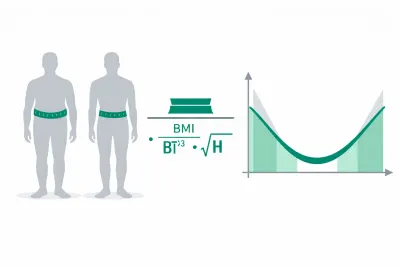
ABSI Calculator: A Body Shape Index & Mortality Risk
Free ABSI calculator computes A Body Shape Index from waist, height, and BMI to estimate visceral fat and mortality risk independent of body mass index.

Adult BMI Calculator for Men & Women — WHO BMI Guide
Use the adult BMI calculator to find your BMI with WHO categories. Enter metric or imperial units to see your status and BMI ranges quickly and clearly.

Army Body Fat Calculator — AR 600‑9 Standard Compliance
Check compliance with the Army body fat calculator per AR 600-9 standards. Enter circumference measures by sex to estimate body fat % and see pass/fail status.
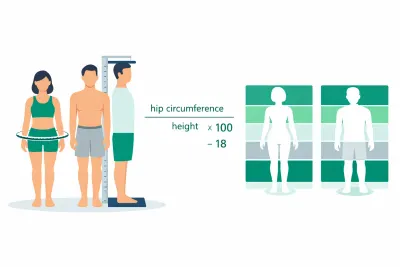
Body Adiposity Index Calculator (BAI) — Body Fat %
Free body adiposity index calculator estimates body fat percentage from hip circumference and height using the BAI formula, no weight or scale needed.
Body Composition Calculator — Fat, Lean Mass Breakdown
Use our body composition calculator to estimate body fat percentage, fat mass, and lean mass from tape measurements. Switch units and get clear categories.

Body Fat Calculator — Percentage for Men & Women (Tape)
Estimate with the body fat percentage calculator (body fat calculator) using Navy circumference equations. Supports metric/imperial and sex‑specific inputs.