Use the Heart Rate Calculator
Measure your pulse and convert taps or a short count into beats per minute (BPM) with this heart rate calculator. Choose tap, timer, or manual mode to find your BPM, see your resting classification, and view training zones.
Your heart rate
Classification
—Taps: 0
Tip: tap at least 6 beats for a stable average. Very fast or very slow taps are filtered out.
This tool is informational and not a medical device. If you have symptoms such as chest pain, dizziness, shortness of breath, or fainting, seek medical care.
Educational tool, not medical advice. Check this tool’s method and limitations before interpreting a result. Talk to a qualified healthcare professional before making decisions about medication, diet, exercise, or treatment. See our Terms of Use.
Your rating helps improve Heart Rate Calculator and Pulse Calculator (BPM). We store only an anonymized vote (no personal data).
How to Use Heart Rate Calculator and Pulse Calculator (BPM)
Step 1: Choose a measurement mode
Select Tap, Timer, or Manual. Tap mode tracks your heartbeat rhythm in real time. Timer mode counts beats over 10–60 seconds. Manual mode converts any beat count into BPM.
Step 2: Measure your pulse
In Tap mode, press the green button with each heartbeat. In Timer mode, start the countdown and tap each beat as you feel it. In Manual mode, enter beats counted and seconds elapsed.
Step 3: Set context and age
Choose Resting, During exercise, or Recovery from the Context dropdown. Enter your age so the calculator can estimate your max heart rate and show training zones.
Step 4: Read your BPM result
Your heart rate appears instantly in beats per minute (BPM) with a color-coded classification, progress bar, and a resting reference table or training zone breakdown.
Step 5: Save or copy your result
Tap Save snapshot to store up to 5 readings for comparison. Use Copy result to share your BPM, classification, and training zone as text.
Key Features
- Tap-to-measure real-time BPM
- 10–60 second timer with beat counter
- Manual pulse count conversion
- Resting, exercise, and recovery modes
- Training zone visualization (zones 1–5)
- Resting HR reference table by fitness level
Understanding Results
Heart rate calculator tips for accurate BPM
Sit still for at least 2 minutes before measuring resting heart rate. Relax your shoulders, breathe normally, and avoid talking. Place two fingers on your radial artery (inner wrist) or carotid artery (side of neck)—use gentle pressure. Count for at least 15 seconds for a quick check, or 30-60 seconds for the most stable result. Measure at the same time of day to make comparisons fair.
Formula
Beats per minute (BPM) expresses how many heartbeats occur in one minute. The heart rate calculator scales a partial count to a full minute: BPM = (beats counted ÷ seconds elapsed) × 60. For example, 22 beats in 15 seconds equals 88 BPM. The tap mode uses the average interval between recent taps: BPM = 60 ÷ average seconds per tap. Training zones use the estimated max HR formula: Max HR = 220 − age.
Reference Ranges
For most healthy adults, resting heart rate falls between 60 and 100 BPM. Athletes often range from 40 to 60 BPM. A resting pulse above 100 BPM (tachycardia) or below 60 BPM (bradycardia) can be normal in certain contexts but warrants attention if accompanied by symptoms. During exercise, 5 training zones scale from 50% to 100% of estimated max HR, helping you target recovery, fat burn, aerobic endurance, threshold, and peak intensity.
Assumptions & Limitations
This pulse calculator is not a medical device. The 220-minus-age formula provides only a rough estimate of max heart rate—individual variation can be 10-20 BPM. Medications (especially beta blockers), dehydration, fever, caffeine, and stress can shift readings. Irregular rhythms (arrhythmias) reduce tap-mode accuracy. Always measure in similar conditions for fair comparisons, and seek medical care if you experience chest pain, fainting, or persistent palpitations.
Complete Guide: Heart Rate Calculator and Pulse Calculator (BPM)

On this page
A heart rate calculator turns a quick pulse check into an actionable number: your beats per minute (BPM). Whether you tap along to your heartbeat, count beats over 15 seconds with a timer, or type in a number you already have, the math is the same—and the result tells you something useful about your cardiovascular state right now. This guide covers the science behind BPM, how to measure accurately, what the numbers mean at rest and during exercise, and when a reading should send you to a clinician rather than back to the calculator.
What heart rate actually tells you
Heart rate is simply how many times your heart contracts in one minute. That single metric reflects a chain of signals: your brain tells the heart to speed up or slow down based on oxygen demand, stress hormones, body temperature, and hydration. A resting rate of 72 BPM means roughly 103,680 beats per day—about 38 million per year. Small changes in that rate can signal shifts in fitness, recovery, illness, or emotional state, which is why tracking it over time is more informative than any single snapshot.
Two people sitting side by side can have resting heart rates 30 BPM apart and both be perfectly healthy. Context—age, fitness history, medications, even genetics—determines what's normal for you. That's why a pulse calculator that provides ranges and classifications is more useful than one that simply shows a number.
How to calculate BPM (heart rate)
The formula is straightforward:
BPM = (beats counted ÷ seconds elapsed) × 60
Worked example: You feel 22 pulses in 15 seconds. Divide 22 by 15 to get 1.467 beats per second, then multiply by 60: 88 BPM. If you counted for 30 seconds instead and felt 44 beats, the math is 44 ÷ 30 × 60 = 88 BPM—same answer, but the 30-second window absorbs small timing errors better. The heartbeat calculator on this page automates this arithmetic for any duration from 10 to 60 seconds.
Tap mode works differently: instead of counting beats over a fixed window, it measures the time between taps and averages the last 3–10 intervals. If the average gap between taps is 0.75 seconds, that translates to 60 ÷ 0.75 = 80 BPM. This approach gives real-time feedback—useful when you want to see your heart rate respond as you warm up or cool down.
Tap vs. timed count: which is better?
Neither method is universally superior. Tapping is faster and reacts to changes within a few seconds, making it ideal for quick spot-checks mid-workout. But it's more sensitive to irregular taps—if you miss one beat or double-tap, the average shifts. A timed 30-second count is more forgiving because one missed beat only changes the result by 2 BPM rather than potentially 10-15 BPM.
| Method | Speed | Stability | Best for |
|---|---|---|---|
| Tap (5-beat) | 3-5 sec | ±5 BPM | Mid-workout checks |
| 15-sec count | 15 sec | ±4 BPM | Quick resting check |
| 30-sec count | 30 sec | ±2 BPM | Accurate resting HR |
| 60-sec count | 60 sec | ±1 BPM | Clinical-grade baseline |
Normal resting heart rate by age and fitness
The American Heart Association considers 60–100 BPM a normal resting range for adults. That's deliberately broad. Within it, lower tends to correlate with better cardiovascular fitness, though exceptions exist (some medications lower heart rate without improving fitness). Here's a practical breakdown:
Once you have counted your BPM, the resting heart rate calculator scores that number against age- and sex-banded norms rather than the single 60–100 window — useful because a 68 BPM reading is average for a man of 40 but sits two categories higher for a woman of 25.
| Resting HR | Classification | Context |
|---|---|---|
| 40–60 BPM | Athletic / bradycardia | Common in trained endurance athletes; asymptomatic is typically fine |
| 60–70 BPM | Excellent to good | Above-average fitness or naturally low resting rate |
| 70–80 BPM | Average | General adult population with moderate activity |
| 80–100 BPM | Below average | May indicate low fitness, stress, dehydration, or stimulants |
| 100+ BPM | Elevated (tachycardia) | Warrants attention, especially if persistent with symptoms |
Children and teenagers have different norms. Newborns can be 120–160 BPM; by age 10, 70–110 BPM is typical. This calculator focuses on adult ranges, but the formula works for any age.
Heart rate training zones explained
Training zones split your effort into intensity bands based on a percentage of your estimated maximum heart rate (max HR). The simplest max HR estimate is 220 minus your age—so a 35-year-old has an estimated max of 185 BPM. More precise formulas exist (Tanaka: 208 − 0.7 × age), but 220-minus-age is the most widely used starting point. You can calculate yours with our Max Heart Rate Calculator.
| Zone | % Max HR | Example (age 35) | Purpose |
|---|---|---|---|
| 1 — Recovery | 50–60% | 93–111 BPM | Warm-up, cool-down |
| 2 — Fat Burn | 60–70% | 111–130 BPM | Aerobic base building |
| 3 — Aerobic | 70–80% | 130–148 BPM | Steady endurance |
| 4 — Threshold | 80–90% | 148–167 BPM | Tempo / lactate threshold |
| 5 — Max | 90–100% | 167–185 BPM | Peak power intervals |
Most recreational exercisers spend the majority of training in zones 2–3. For structured zone-2 work—the "conversational pace" that builds aerobic efficiency—check our Zone 2 Heart Rate Calculator. If you want to connect heart rate to aerobic capacity, the VO2 Max Calculator puts your numbers in a broader fitness context.
Recovery heart rate and what it signals
Recovery heart rate is the drop in BPM during the first minute after you stop exercise. A larger drop generally reflects stronger parasympathetic ("rest and digest") function and better cardiovascular fitness. A study published in the New England Journal of Medicine found that a recovery drop of less than 12 BPM after one minute was associated with higher mortality risk in a clinical population. For recreationally active adults, a 20–40 BPM drop is common; elite athletes may see 50+ BPM.
To measure recovery heart rate: finish a steady-effort interval, note your BPM immediately (use tap mode for a quick read), then sit down and take a 60-second timed count one minute later. The difference is your 1-minute recovery value. Track it weekly under similar conditions—improvement over months is a strong sign of rising fitness. If you want to pair heart rate data with blood pressure monitoring, our Blood Pressure Calculator provides additional cardiovascular context—and because a fast pulse skews the standard perfusion formula by 5+ mmHg, the mean arterial pressure calculator can rate-correct the estimate using the same heart rate you just measured.
Factors that shift your heart rate
Heart rate isn't static, and understanding what moves it helps you interpret readings correctly:
- Caffeine can raise resting HR by 3–15 BPM for 1–3 hours depending on tolerance and dose.
- Dehydration reduces blood volume, forcing the heart to beat faster to maintain output. Even 2% body weight loss in fluid can add 5–10 BPM.
- Sleep deprivation elevates resting HR and blunts recovery—a single night of poor sleep can add 5+ BPM the next morning.
- Temperature matters. Hot environments increase heart rate by 5–20 BPM at the same exercise intensity (cardiac drift).
- Medications like beta blockers reduce heart rate by 10–30 BPM regardless of fitness. Stimulant medications do the opposite.
- Illness and fever raise resting HR roughly 8–10 BPM per degree Celsius of body temperature increase.
- Stress and anxiety activate the sympathetic nervous system, elevating heart rate even while sitting still.
This is why consistent measurement conditions matter more than any single number. A morning resting check after waking, before coffee, lying in bed for 2 minutes is the gold standard for a reproducible baseline.
Common pulse measurement mistakes
After using this pulse calculator with hundreds of users, certain errors come up repeatedly:
- Pressing too hard on the carotid artery. Firm pressure on the neck can actually slow your heart rate (carotid sinus reflex) and make you feel lightheaded. Use gentle touch—just enough to feel the pulse.
- Holding your breath while counting. Breath-holding activates the vagus nerve and can drop your heart rate temporarily. Breathe normally throughout.
- Measuring right after standing up. Heart rate spikes briefly when you go from sitting to standing. Wait 30 seconds before starting a resting measurement.
- Comparing measurements taken in different conditions. A bedtime reading will be 5–15 BPM lower than a mid-afternoon one. Always note the time and context.
- Using too few taps in tap mode. Three taps (two intervals) can swing wildly. Use at least 5–8 taps for a stable average, especially if your rhythm isn't perfectly regular.
How to lower your resting heart rate
Resting heart rate is one of the most responsive fitness markers. Consistent aerobic exercise—walking 30 minutes daily, gentle cycling, swimming—can lower resting HR by 5–15 BPM over 8–12 weeks. The mechanism is straightforward: the heart becomes a more efficient pump, pushing more blood per beat (higher stroke volume), so it doesn't need to beat as often.
Beyond exercise, adequate sleep (7–9 hours), hydration, stress management, and limiting stimulants all contribute. If you track your nutrition alongside heart rate, our Calories Burned Calculator helps you balance energy expenditure. For runners, pairing heart rate data with pace targets using the Running Pace Calculator makes zone-based training practical.
When to see a doctor about your heart rate
A BPM calculator is a screening tool, not a diagnostic one. Contact a healthcare provider if your resting heart rate is persistently above 100 BPM or below 40 BPM and you have symptoms like dizziness, chest pressure, shortness of breath, or unexplained fatigue. An irregular rhythm that you can feel (skipped beats, racing episodes) also warrants evaluation, even if the average BPM looks normal. If you experience chest pain, fainting, or severe breathlessness, skip the calculator and go to urgent care.
For general cardiovascular health information, the American Heart Association's target heart rate guide and the CDC's physical activity guidelines are reliable, non-commercial starting points.
References: American Heart Association — Target Heart Rates (2024). Centers for Disease Control and Prevention — Physical Activity Basics. Jouven X et al. "Heart-Rate Profile during Exercise as a Predictor of Sudden Death." N Engl J Med 2005;352:1951-1958.

Written by Marko Šinko
Co-Founder & Lead Developer
Computer scientist and developer working on calculator implementation, data handling, and accessible interfaces. His authorship describes development work, not independent medical review.
View full profileFrequently Asked Questions
How does this heart rate calculator work?
It converts your pulse count into beats per minute (BPM). Tap mode averages the time between your taps. Timer mode divides your beat count by elapsed seconds and multiplies by 60. Manual mode applies the same formula to any count you enter: BPM = (beats / seconds) x 60.
What is a normal resting heart rate for adults?
Most healthy adults have a resting heart rate between 60 and 100 BPM. Well-trained endurance athletes often fall in the 40-60 BPM range. Trends matter more than a single reading, so check under similar conditions a few mornings each week.
How do I calculate BPM from a 15-second pulse count?
Count beats for 15 seconds and multiply by 4. For example, 22 beats in 15 seconds equals 88 BPM. Longer counts (30 or 60 seconds) give more stable results because small timing errors get averaged out.
How accurate is the tap-to-measure pulse calculator?
The tap mode averages your last 3-10 tap intervals and filters out unrealistically fast or slow taps. With at least 6 steady taps, accuracy is typically within 2-3 BPM of a chest strap for resting measurements. Movement and inconsistent rhythm reduce accuracy.
What are heart rate training zones?
Training zones divide your effort into 5 levels based on percentage of max heart rate. Zone 1 (50-60%) is recovery, Zone 2 (60-70%) builds aerobic base, Zone 3 (70-80%) is steady endurance, Zone 4 (80-90%) is threshold work, and Zone 5 (90-100%) is peak intervals.
Why does my heart rate vary from reading to reading?
Heart rate responds rapidly to breathing, posture, stress, temperature, hydration, caffeine, and even digestion. Variability of 5-10 BPM between consecutive readings is normal. Measure in the same position at the same time of day for the most comparable results.
Can I use this pulse calculator during exercise?
Yes. Use the Tap mode for quick mid-workout checks or the Timer mode for a controlled count during rest intervals. Select During exercise as the context to see your current training zone. Avoid talking or holding your breath while measuring.
When should I see a doctor about my heart rate?
Seek medical care if your resting heart rate is consistently above 100 BPM or below 40 BPM with symptoms like dizziness, chest pain, fainting, or shortness of breath. This calculator is informational and not a medical device.
Related Calculators
A1C Calculator — Convert HbA1c to eAG with Targets
Use our A1C calculator to convert HbA1c to estimated average glucose (eAG). See normal, prediabetes, and diabetes thresholds in mg/dL and mmol/L. Fast results.
Albumin Calculator — Serum Albumin Level Interpretation
Free albumin calculator to interpret serum albumin levels, grade hypoalbuminemia, and compute A/G ratio plus albumin-corrected calcium from your lab results.
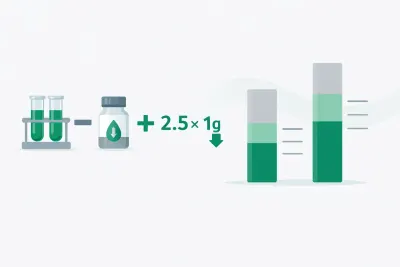
Albumin-Corrected Anion Gap Calculator — Hidden Acidosis
Use our albumin-corrected anion gap calculator to raise the anion gap by 2.5 per 1 g/dL of low albumin and reveal a hidden high-gap metabolic acidosis.

ANC Calculator: Absolute Neutrophil Count & Neutropenia
Free ANC calculator to calculate absolute neutrophil count from WBC and differential. Get ANC in cells/uL and x10^9/L with instant neutropenia grading.
Anion Gap Calculator — Metabolic Acidosis Evaluation
Free anion gap calculator finds serum anion gap from sodium, chloride, and bicarbonate, with albumin correction and delta ratio for metabolic acidosis.
AST/ALT Ratio Calculator — Free De Ritis Ratio Tool
Use our free AST/ALT ratio calculator to compute the De Ritis index instantly. Visual ratio chart, enzyme-level assessment, and clinical patterns guide.