Use the Head Circumference Percentile Calculator
Enter age (0–60 months), sex, and head measurement to see percentile, z‑score, reference values, and an interactive WHO growth chart.
Calculate head circumference percentile
WHO standards cover birth to 60 months (5 years).
Measure at the widest point — above eyebrows and around the occiput. Take 2–3 readings and use the largest.
Head circumference growth chart (boys)
Measurement history
Track changes over time. Download CSV to share with your pediatrician.
No measurements saved yet. Calculate a result and tap "Add to history" to start tracking.
This tool estimates head circumference percentiles using WHO growth standards (LMS method) for children 0–60 months. Results are for informational purposes only and do not constitute medical advice.
Educational tool, not medical advice. Check this tool’s method and limitations before interpreting a result. Talk to a qualified healthcare professional before making decisions about medication, diet, exercise, or treatment. See our Terms of Use.
Your rating helps improve Head Circumference Percentile Calculator: WHO Growth Chart. We store only an anonymized vote (no personal data).
How to Use Head Circumference Percentile Calculator: WHO Growth Chart
Step 1: Choose Sex & Enter Age
Select boy or girl. Enter age in months (0–60) or switch to years + months. WHO standards cover birth to 5 years.
Step 2: Enter Head Circumference
Type the head circumference in cm or inches. Measure at the widest point — above eyebrows and around the occiput. Use the largest of 2–3 readings.
Step 3: View Percentile, Z‑Score & Chart
Results appear instantly: percentile, z‑score, reference values (3rd, 50th, 97th), and an interactive WHO growth chart showing your child's position.
Step 4: Track Over Time
Tap "Add to history" to save the measurement. History points appear on the growth chart. Download CSV to share with your pediatrician.
Key Features
- WHO head circumference percentiles for 0–60 months
- Interactive growth chart with percentile curves
- Percentile, z-score, and reference range display
- Measurement history with CSV export for pediatrician visits
- Supports cm and inches with age in months or years
- Works fully offline — no data leaves your device
Understanding Your Head Circumference Percentile Results
Reading the head circumference percentile calculator output
After entering age (0–60 months), sex, and head circumference, the calculator displays your child's percentile, z‑score, reference values (3rd, 50th, and 97th percentiles for the same age), and an interactive WHO growth chart. Use the result as a quick screening snapshot, then track trends over time by adding measurements to history.
Formula — the LMS method
The head circumference percentile calculator uses the LMS method, the statistical backbone of WHO Child Growth Standards. For every month of age and each sex, three parameters describe the measurement distribution: L (skewness), M (median), and S (coefficient of variation). Your child's measurement is converted to a z‑score using the Cole–Green equation. When L is close to zero, the formula simplifies to a log transform divided by S.
The z‑score tells you how many standard deviations above or below the median your child's head size lies. A z of 0 equals the 50th percentile. Values of ±1 correspond to roughly the 16th and 84th percentiles, ±2 to the 2nd and 98th percentiles. We interpolate between monthly reference values so fractional ages (e.g., 2 years and 3 months) yield smooth results.
Reference ranges and interpretation
Most healthy children measure between the 5th and 95th percentiles on the WHO head circumference chart. Values persistently below the 3rd or above the 97th percentile are uncommon and may prompt further attention — especially if paired with other growth concerns or a sharp change in trend. Always consider measurement technique, parental head sizes (genetics), and overall growth (weight and length/height) when interpreting a single point.
Authoritative references include the WHO Child Growth Standards (birth to 5 years) and the CDC Growth Charts (head circumference through 36 months). Our calculator is informational and privacy‑first — no data leaves your device.
Assumptions and limitations
This head circumference percentile calculator uses smooth LMS parameter approximations to stay fast and fully offline. It covers birth to 60 months (5 years), matching the WHO standard age range. Results are for information and growth tracking only — not a medical diagnosis. Head circumference is one part of a broader growth assessment. If you have concerns about your child's results or growth trend, consult your pediatrician.
Complete Guide: Head Circumference Percentile Calculator: WHO Growth Chart

On this page
Free head circumference percentile calculator with WHO growth chart. Enter age (0‑5 years), sex, and measurement to get percentile, z‑score, and visual chart.
Head circumference is one of the three core measurements pediatricians track at every well‑child visit, alongside weight and length (or height). Our head circumference percentile calculator turns a single tape‑measure reading into an easy‑to‑read percentile and z‑score so you can see exactly where your child sits on the WHO head circumference chart compared to peers of the same age and sex.
Why head circumference matters for infant growth
Head circumference is a simple, non‑invasive proxy for skull and brain growth. During the first two years of life, the skull expands rapidly — growing roughly 12 cm in boys and 11 cm in girls. This rapid expansion reflects the developing brain, which triples in weight by age three. Tracking head circumference by age helps pediatric teams spot patterns that might warrant closer follow‑up, such as unusually rapid or slow growth.
A single measurement is informative; a series of measurements over weeks and months is far more valuable because it reveals the trend. A head circumference percentile calculator makes it easy to convert raw measurements into a standardized score at each visit, so you can see whether your child is tracking steadily along one band or drifting up or down.
Head circumference by age: what to expect
Normal head circumference varies significantly by age and sex. The table below shows approximate 50th‑percentile (median) values from the WHO Child Growth Standards:
| Age | Boys (median) | Girls (median) |
|---|---|---|
| Birth | 34.5 cm | 33.9 cm |
| 3 months | 39.5 cm | 38.5 cm |
| 6 months | 42.1 cm | 40.9 cm |
| 12 months | 44.7 cm | 43.3 cm |
| 18 months | 46.0 cm | 44.5 cm |
| 24 months | 46.9 cm | 45.3 cm |
| 36 months (3y) | 48.3 cm | 46.4 cm |
| 48 months (4y) | 49.2 cm | 47.0 cm |
| 60 months (5y) | 49.8 cm | 47.5 cm |
Notice how growth is fastest in the first year and then gradually slows. By age five, head circumference has reached about 90% of adult size. These median values represent the 50th percentile — half of healthy children measure above and half below. Use our head circumference percentile calculator to see exactly where your child falls on this scale.
How the head circumference percentile calculator works
This calculator uses the LMS method — the same statistical approach behind the WHO Child Growth Standards. For every month of age and each sex, the growth distribution is described by three parameters: L (skewness, how asymmetric the distribution is), M (median, the 50th percentile value), and S (coefficient of variation, the spread). Your child's measurement is converted to a z‑score using the Cole–Green equation, which accounts for the distribution's shape at that specific age.
The z‑score is then mapped to a percentile using the standard normal distribution. A z of 0 equals the 50th percentile. A z of ±1 corresponds to roughly the 16th and 84th percentiles. A z of ±2 corresponds to the 2nd and 98th percentiles. Because growth is continuous, we interpolate between monthly reference values so fractional ages (e.g., 6.5 months or 2 years 3 months) produce smooth, accurate estimates.
Understanding the WHO head circumference chart
The WHO head circumference chart displays curved lines representing specific percentiles (typically the 3rd, 15th, 50th, 85th, and 97th) from birth to 60 months. Each curve shows the expected head size at that percentile for every month of age. Our interactive chart above the article mirrors these curves and plots your child's measurement as a dot so you can see their position at a glance.
The shaded area between the 2nd and 98th percentile curves represents the range where the vast majority of healthy children fall. A child tracking along the 25th percentile line at every visit is growing normally — that line simply reflects their individual pattern. What matters most is consistency: a measurement that jumps from the 25th to the 75th percentile (or drops from the 60th to the 10th) in a short time deserves a conversation with your pediatrician.
You can view the official WHO charts and data tables at the WHO Child Growth Standards page. For U.S.‑specific reference, the CDC Growth Charts also include head circumference-for-age through 36 months.
How to measure head circumference accurately
Accurate measurement technique is critical — even 0.5 cm can shift a percentile by several points in early infancy. Follow these steps for a reliable reading:
- Use the right tape: A flexible, non‑stretch measuring tape (cloth or disposable paper). Metal tapes and string are less accurate.
- Position the tape correctly: Wrap it around the widest part of the head — just above the eyebrows in front, above the ears on the sides, and over the most prominent part of the occiput (back of the head).
- Keep it level: The tape should be horizontal and snug without compressing soft tissue or hair.
- Take multiple readings: Measure two or three times and record the largest value to the nearest 0.1 cm (1 mm).
- Be consistent: Measure at roughly the same time of day, in a calm setting, and with the same technique each time. This reduces noise in the growth trend.
If you get a surprising result, repeat the measurement before worrying. When in doubt, your pediatrician can measure during the next well‑child visit and compare to their own records.
Interpreting head circumference z‑scores and percentiles
A percentile tells you the percentage of same‑age, same‑sex children who measure below your child. The 60th percentile means "larger than 60% of peers." A z‑score expresses the same idea on a standard deviation scale, making it easier to compare across growth parameters (weight, length, head circumference). Here is a quick reference:
| Z‑score | Percentile | Interpretation |
|---|---|---|
| −3 | 0.1th | Severely below median — urgent follow‑up |
| −2 | 2.3rd | Below normal range — evaluate further |
| −1 | 15.9th | Low‑normal — typically no concern |
| 0 | 50th | Median (exactly average) |
| +1 | 84.1st | High‑normal — typically no concern |
| +2 | 97.7th | Above normal range — evaluate further |
| +3 | 99.9th | Severely above median — urgent follow‑up |
Remember: a single measurement slightly outside the typical range can reflect genetics, measurement technique, or temporary factors. Trends over time, combined with weight and length/height, tell a much clearer story than any single point.
Corrected age for preterm infants
If your child was born before 37 weeks of gestation, pediatricians typically use corrected age (also called adjusted age) for growth tracking during the first two years. Corrected age is calculated by subtracting the number of weeks born early from the child's chronological age. For example, a baby born at 34 weeks (6 weeks early) who is now 4 months old has a corrected age of about 2.5 months.
Using corrected age produces a fairer comparison against the WHO head circumference chart, because it accounts for the fact that preterm infants have had less time to grow. If you are unsure whether to use corrected or chronological age, ask your pediatrician — and be consistent from visit to visit so the trend line remains meaningful. Our Gestational Age Calculator can help you verify dates.
When to discuss results with a pediatrician
Consider contacting your pediatrician if:
- Head circumference is persistently below the 3rd percentile or above the 97th percentile.
- The percentile shifts sharply over a short period (e.g., from the 50th to the 10th in two months).
- The fontanelle (soft spot) appears unusually bulging or sunken.
- You notice developmental concerns alongside unusual head size trends.
Your pediatrician may repeat measurements, review birth history, assess the fontanelle, and consider additional evaluation when indicated. Bringing a short log showing age, head circumference, and percentile from our calculator's history feature makes the conversation more productive.
Tracking head circumference over time
Growth is a journey, not a single checkpoint. To build a useful trend, measure with the same technique and units each time, and keep intervals reasonably consistent. Many caregivers log monthly values during the first year, then every 2–3 months during years two through five. Our calculator's "Add to history" button and CSV download make it easy to maintain and share a record.
The interactive growth chart in our calculator plots all your saved measurements on the WHO percentile curves, so you can visually see whether your child is tracking along one band or drifting. Pair head circumference tracking with weight and length for a complete growth picture.
For complementary tools, try our Baby Weight Percentile Calculator, Baby Length Percentile Calculator, Child Height Percentile Calculator, and Baby Growth Calculator for a broader snapshot. The Growth Chart Calculator is a great companion for visualizing multiple metrics together.
Related growth metrics to check
Growth is multidimensional. Pair head circumference with other measurements to get the full picture:
- Body size: Child BMI Percentile Calculator and Child Growth Calculator
- Infant nutrition: Newborn Feeding Calculator and Breastfeeding Calculator
- Growth trends: Growth Calculator and Growth Chart Calculator
These tools complement each other. For example, a child may have a larger head‑circumference percentile with an average weight percentile — this is often familial and perfectly normal. Context helps your pediatrician interpret those differences. If measurements seem inconsistent across visits, revisit your technique and consider scheduling a calm, consistent time of day for repeat checks.
Assumptions, limitations, and responsible use
Our head circumference percentile calculator uses well‑established z‑score mathematics with smooth, realistic LMS parameter approximations matching WHO Child Growth Standards. It covers children from birth to 60 months (5 years) and is designed for information and growth tracking — not diagnosis or medical advice.
Limitations to keep in mind: percentiles are population‑level reference points, not individual targets. They don't account for genetics, ethnicity‑specific growth patterns, or individual health conditions. Measurement error, especially in squirmy infants, can shift results by several percentile points. Always interpret results in partnership with your pediatric team.
For authoritative sources on growth standards, consult:
- WHO Child Growth Standards — International reference for children 0–5 years
- CDC Growth Charts — U.S. reference including head circumference through 36 months

Written by Marko Šinko
Co-Founder & Lead Developer
Computer scientist and developer working on calculator implementation, data handling, and accessible interfaces. His authorship describes development work, not independent medical review.
View full profileFrequently Asked Questions
What does a head circumference percentile show?
It compares your child’s head size with children of the same age and sex using WHO growth standards. The 70th percentile means larger than 70% of peers. The result helps screen for unusual growth patterns.
How does this head circumference percentile calculator work?
It uses the LMS method from WHO Child Growth Standards to compute a z-score from age, sex, and measurement, then maps it to a percentile. We interpolate between monthly reference values for smooth results across fractional ages.
What is a normal head circumference by age?
Normal head circumference varies by age and sex. At birth, boys average about 34.5 cm and girls 33.9 cm. By 12 months, boys reach about 44.7 cm and girls 43.3 cm. By 5 years, boys average 49.8 cm and girls 47.5 cm. Values between the 5th and 95th percentiles are considered typical.
What do WHO head circumference z-scores mean?
A z-score of 0 equals the 50th percentile (median). A z of +1 means one standard deviation above the median (about the 84th percentile), and −2 corresponds to roughly the 2nd percentile. WHO flags z-scores below −2 or above +2 for closer follow-up.
What ages does the head circumference chart cover?
Our calculator and growth chart cover birth to 60 months (5 years), matching WHO head-circumference-for-age standards. This is the period of fastest skull growth. For children over 5, head growth slows significantly and standard charts are less commonly used.
Should I use corrected age for preterm infants?
Yes, clinicians typically use corrected age (chronological age minus weeks born early) for growth tracking in the first two years for preterm babies. Ask your pediatrician and be consistent from visit to visit so the growth trend remains meaningful.
How do I measure head circumference accurately at home?
Use a flexible, non-stretch tape. Place it above the eyebrows, above the ears, and around the most prominent part at the back of the head (occiput). Keep it level. Take 2–3 readings and record the largest value to the nearest 0.1 cm. Even 0.5 cm can shift a percentile noticeably in infancy.
Is this calculator a substitute for medical advice?
No. It provides informational estimates based on WHO reference data and is not a diagnosis. If your child’s head circumference is persistently below the 3rd or above the 97th percentile, or if trends change sharply, consult your pediatrician for a full evaluation.
Related Calculators
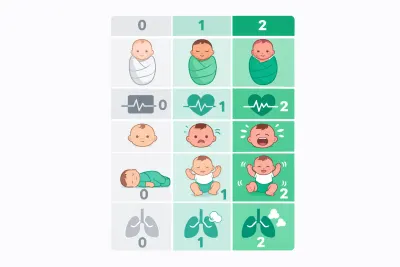
Apgar Score Calculator — Newborn Health at 1 & 5 Minutes
Use the Apgar score calculator to rate a newborn at 1 and 5 minutes across heart rate, breathing, muscle tone, reflexes, and skin color on a 0 to 10 scale.

Baby Food Calculator — Solids Introduction & Portions
Estimate age‑appropriate portions and plan meal frequency with the baby food calculator. Log new foods, track allergens, and export a simple weekly menu.

Infant Growth Chart Calculator
Track weight, length, and head size with the infant growth chart calculator using WHO percentiles. See trends on clear charts and compare age-based progress.

Baby Length Percentile Calculator — WHO Reference Guide
Check WHO length‑for‑age percentiles with the baby length percentile calculator. Input age, sex, and length to see your percentile and track growth trends.

Baby Milestone Calculator — Track Skills by Age & Stage
Use our baby milestone calculator to see what’s typical by corrected age. Explore early, typical, and later windows for motor, language, and cognitive skills.

Baby Weight Percentile Calculator — WHO Growth Guide
Use the baby weight percentile calculator to see WHO weight‑for‑age percentiles. Enter age, sex, and weight to get your percentile, z‑score, and tips.