Cat Calorie Calculator — Enter Your Cat's Details
This cat calorie calculator estimates daily kcal needs and converts them into grams, cups, or cans of your specific food. Enter weight, life stage, neuter status, and activity level to get results instantly.
Daily Calories
260 kcal/day
RER
216 kcal
Energy multiplier: × 1.20 (Adult, neutered, low activity)
Daily Calories (MER)
260
kcal / day
RER
216
kcal/day
Multiplier
× 1.20
Adult
Meals / day
2
130 kcal each
Food energy density (optional — converts kcal to portions)
Find calories per cup, per 100 g, or per can on the food label or the brand's website.
For guidance only. Ask your veterinarian for tailored advice.
Daily Calorie Reference (Neutered Adult Cats)
Approximate kcal/day at different activity levels using RER × multiplier
| Weight (kg) | Low | Moderate | High |
|---|---|---|---|
| 2.5 | 130 | 155 | 180 |
| 3.5 | 165 | 195 | 225 |
| 4 | 180 | 215 | 250 |
| 4.5 | 200 | 235 | 275 |
| 5 | 215 | 255 | 295 |
| 5.5 | 230 | 275 | 315 |
| 6 | 245 | 290 | 335 |
| 7 | 275 | 325 | 375 |
Disclaimer: These estimates use standard veterinary equations (RER × activity multiplier) and are meant for general guidance. Individual cats vary in metabolism and health needs. Always consult your veterinarian before making significant diet changes, especially for kittens, seniors, or cats with medical conditions.
Educational tool, not medical advice. Check this tool’s method and limitations before interpreting a result. Talk to a qualified healthcare professional before making decisions about medication, diet, exercise, or treatment. See our Terms of Use.
Your rating helps improve Cat Calorie Calculator: Daily Kcal and Feeding Guide. We store only an anonymized vote (no personal data).
How to Use Cat Calorie Calculator: Daily Kcal and Feeding Guide
Step 1: Choose units & weight
Pick Metric (kg) or US (lb) and enter your cat's current weight. For weight goals, add a target weight.
Step 2: Select life stage
Choose kitten, adult, senior, or pregnant/lactating and set spayed/neutered or intact.
Step 3: Set activity & goal
Pick low, moderate, or high activity, then choose maintain, weight loss, or weight gain.
Step 4: Add food calories (optional)
Enter kcal per 100 g, per cup, or per can from your label to convert to grams, cups, or cans.
Step 5: Review portions
See daily kcal plus grams/cups/cans per day and per meal. Adjust every 2–4 weeks based on weight.
Key Features
- RER & MER calorie calculation by weight
- Life stage, neuter status & activity factors
- Kcal-to-grams, cups & cans conversion
- Weight loss and gain planning modes
- Reference table for common cat weights
- Copy results for vet visits
Understanding Results
Formula
The calculator estimates daily calories in two steps. First, it calculates Resting Energy Requirement (RER), a baseline for energy used at rest: RER = 70 × (weight in kilograms)0.75. Second, it multiplies RER by a factor based on your selections for life stage, spayed/neutered status, and activity to estimate Maintenance Energy Requirement (MER), which is the number of calories to feed per day.
The tool also supports goals. For weight maintenance it uses current weight. For weight loss or gain it estimates from a target weight to keep your plan oriented toward where you want to be.
Reference Ranges & Interpretation
Many indoor, neutered adult cats maintain around 1.2–1.4 × RER. More active or intact adults may need closer to 1.4–1.8 × RER. Kittens typically need higher multipliers, and pregnant or lactating queens can require 2–4 × RER or more depending on litter size. Use these as guides, not hard rules — the most important signal is how your cat’s body weight and condition change over time.
After you have a daily MER, enter your food’s calories per cup, per 100 g, or per can to translate calories into portions. If the food changes, re-check the label and adjust. For humans planning alongside their pets, tools like the Calorie Calculator and TDEE Calculator can help organize your own intake while you adjust your cat’s plan.
Assumptions & Limitations
These equations are practical averages. They don’t replace individualized veterinary guidance or account for every condition. Some cats have medical needs (e.g., kidney or thyroid disease) that change calorie targets or diet type. If appetite changes suddenly, weight moves quickly, or your cat seems unwell, contact your veterinarian. For routine planning, reassess portions every 2–4 weeks and aim for gradual, predictable trends.
Finally, treats and scraps count. If you share bites from the table, include them in your day’s calories or keep them small so they don’t quietly erase your plan.
Complete Guide: Cat Calorie Calculator: Daily Kcal and Feeding Guide
On this page
A cat calorie calculator turns your cat's weight, age, and activity level into a daily kcal target you can actually use at feeding time. Most cat owners know they should measure portions, but without a concrete calorie number the advice stays vague. This tool gives you that number in seconds, then converts it into grams, cups, or cans of your specific food.
The real payoff is consistency. Once you know your cat needs, say, 200 kcal per day, you can weigh portions with a kitchen scale and stop guessing. If you're also curious about your pet's body condition trend, try our Pet BMI Calculator after you run the calorie numbers.
How this cat calorie calculator works
The calculator uses a standard veterinary equation to estimate resting energy requirement (RER), then multiplies it by a factor for life stage, neuter status, and activity to get maintenance energy requirement (MER). You enter weight, pick a life stage, set reproductive status and activity, and the tool does the rest automatically — no button to press.
If your goal is weight loss or weight gain, you enter a target weight too. The calculation then bases the calorie estimate on where you're heading, not where you are. That small shift matters: feeding 0.8 × RER of a 4 kg target weight gives a different number than 0.8 × RER of a 5.5 kg current weight.
Next, you can optionally enter your food's calorie density — kcal per 100 g, per cup, or per can — from the label. The calculator converts daily kcal into grams, cups, or cans per day and splits them across your chosen number of meals. Everything updates live so you can experiment with different foods or portion splits instantly.
Internally, all math runs in metric. If you enter pounds, the tool converts accurately before calculating and shows results in the unit you chose. This avoids rounding drift and keeps numbers consistent if you toggle between metric and US units.
RER vs MER: what the numbers mean
Resting Energy Requirement (RER) is the baseline — how many kilocalories a cat burns at rest in a neutral temperature. The standard veterinary formula is RER = 70 × (body weight in kg)0.75. For a typical 4.5 kg adult cat, that comes out to about 198 kcal.
Maintenance Energy Requirement (MER) is the practical feeding target. It multiplies RER by a factor that accounts for real life: activity, whether the cat is spayed or intact, age group, and whether the cat is growing, pregnant, or nursing. MER is the number you'll use to measure food.
Don't chase the last digit. These equations are clinical approximations, not lab measurements. The power formula (kg0.75) works well across a wide weight range, but any individual cat can differ by 10–15% from the estimate. The right approach: start with the calculated MER, measure portions for two to four weeks, then adjust based on what the scale says.
Choosing the right multiplier
Multipliers bridge the gap between resting energy and real-world feeding. A neutered indoor adult typically maintains on 1.2–1.4 × RER — roughly 240–280 kcal per day for a 4.5 kg cat. An intact or outdoor-active cat may need 1.4–1.8 × RER because muscle mass and movement burn more fuel.
The calculator picks a sensible default based on your inputs and displays the exact multiplier it used. If you know your cat gains weight easily (common for indoor neutered cats), start with the lower activity setting. Re-weigh after two to four weeks. If weight is stable and your cat looks healthy, you've found the right level.
Senior cats sometimes need a slight downward adjustment because baseline metabolism slows. The calculator handles this automatically (−0.1 from the base multiplier for seniors). But some older cats actually need more calories if they start losing muscle mass, so watch the trend closely and talk to your vet if weight drops unexpectedly.
Kittens, pregnancy and lactation
Growing kittens have much higher calorie needs per kilogram than adults. From 0–4 months, many kittens thrive around 2.5 × RER. From 4–12 months, roughly 1.5–2.0 × RER as growth tapers. Pregnant queens need about 2.0 × RER in late gestation, and lactating queens can require 2–4 × RER or even more with large litters.
These life stages change rapidly. A kitten that needed 300 kcal at three months may only need 250 at eight months. Re-run the cat calorie calculator every few weeks during growth and use your veterinarian's guidance for kittens under 4 months. Our Cat Age Calculator can help translate kitten age into developmental context.
For weaning kittens, mix kitten-appropriate wet food with warm water to create a thin gruel, then reduce water gradually over several days. Offer small, frequent meals in shallow bowls. When in doubt, go slower — a steady appetite and comfortable digestion matter more than speed.
Convert kcal to cups, grams and cans
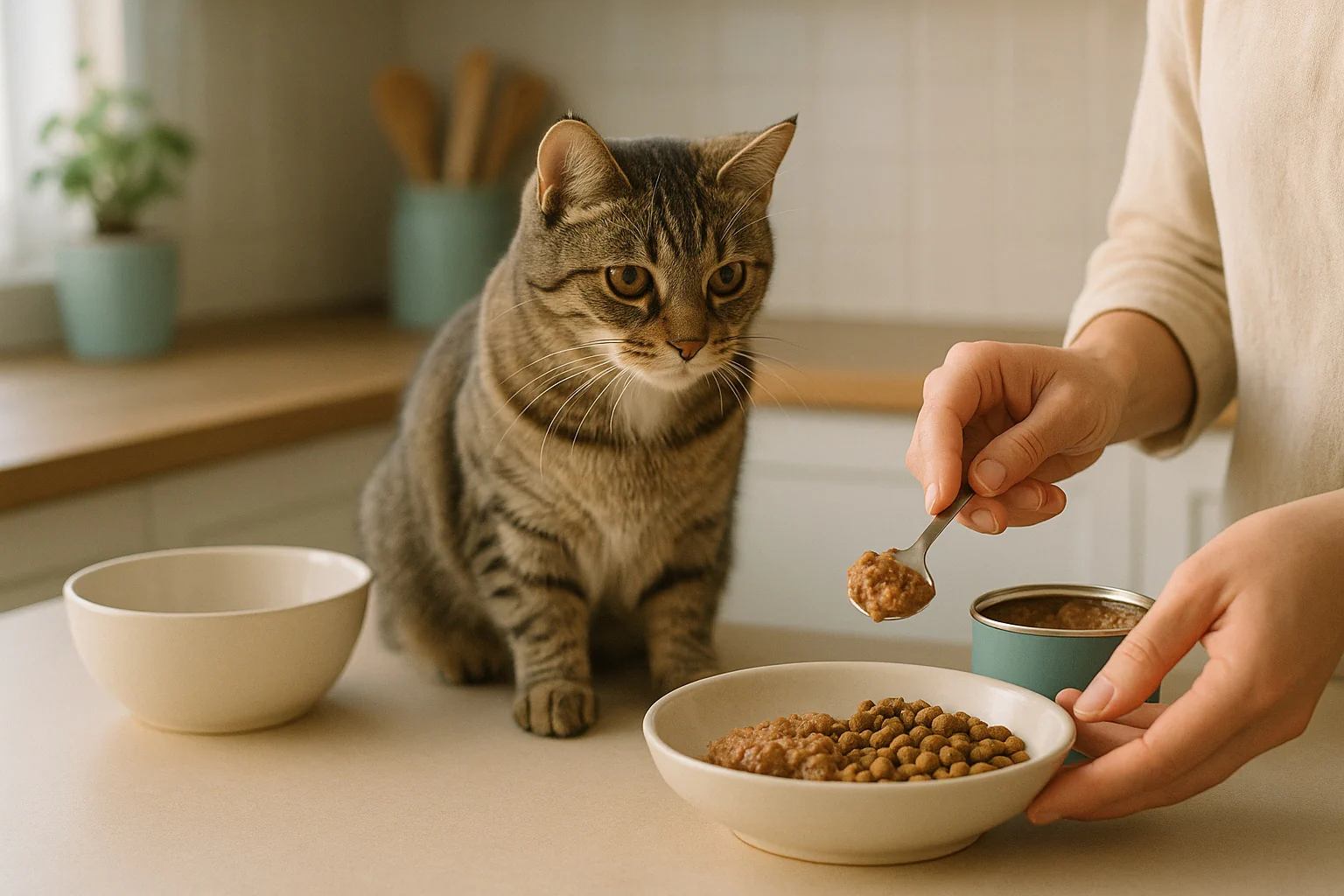
A kcal number is only useful once you can translate it into a scoop of food. Most dry foods list kcal per cup and kcal per 100 g. Most wet foods list kcal per can and the can's weight. Enter whichever value you have and the calculator instantly shows portions.
Worked example: Your cat needs 200 kcal/day. The dry food label says 380 kcal per 100 g and 450 kcal per cup. All-dry feeding: 200 ÷ 3.8 = 53 g/day, or 200 ÷ 450 = 0.44 cups/day. Split across two meals, that's about 26 g or 0.22 cups per meal. If you feed half wet (95 kcal per 3-oz can) and half dry: 1.05 cans/day + 0.22 cups/day.
A kitchen gram scale makes portions repeatable. If you prefer volume measures, use the same scoop and level it consistently. Re-measure whenever you switch foods — calorie density varies 10–20% between brands and recipes.
Can sizes vary too (3 oz, 5.5 oz, 12 oz). Always use the kcal per can from your actual label rather than assuming. If your brand lists calories per kilogram for wet food, divide by 1,000 to get kcal per gram, then multiply by your portion's grams.
Safe weight loss and gain in cats
Before cutting calories, figure out how much weight your cat actually needs to lose. Our cat weight calculator estimates an ideal range from body condition score and frame size, then shows a safe weekly pace and timeline. For a more objective starting point, the cat BMI calculator estimates body fat percentage from two tape measurements — useful when a fluffy coat hides fat gain from the eye.
For weight loss, many veterinarians target 0.8 × RER of the goal weight, then adjust every two to four weeks based on progress. Cats should lose weight slowly — about 1–2% of body weight per week — to protect lean tissue and avoid hepatic lipidosis (fatty liver), a serious condition that can develop when overweight cats stop eating or lose weight too fast.
For weight gain after illness or rescue, modest calorie surpluses with energy-dense foods work best. Increase portions by 10–15% above maintenance and monitor weekly. If your cat isn't gaining, rule out medical issues before adding more food.
A practical approach: pick a target, measure portions carefully, and set a reminder to weigh every two weeks. If weight stalls for a month, review treats and leftovers, then adjust food by 5–10%. Slow, steady change is the goal — calm behavior, good litter habits, and normal energy are your green lights.
Feeding routines that actually work
Success comes from routine more than perfection. Feed at consistent times. Most adult cats do well with two meals per day; some prefer three smaller meals. Keep water bowls fresh and positioned away from litter boxes and food. If your cat eats too fast, spread food on a shallow plate or use a puzzle feeder to slow things down.
- Measure every meal. A scale beats a scoop for accuracy.
- Weigh your cat monthly — aim for slow, predictable change toward your target.
- Count treats toward the daily calorie budget. Even a few kibbles add up.
- Transition foods gradually over 5–7 days to avoid digestive upset.
Multi-cat homes add complexity. If one cat needs fewer calories, feed in separate rooms with doors closed until bowls are empty. Automatic microchip feeders can help ensure the right cat gets the right portion. For grazers, measure the full day's portion and offer it in small amounts to prevent over-serving.
Common cat feeding mistakes
Eyeballing portions is the number-one mistake. A tablespoon of extra kibble can add 20–30 kcal, and over a month that's enough to push weight in the wrong direction. Other common pitfalls: frequent table scraps that aren't counted, switching foods so often you can't tell what's working, and relying solely on cup measures when the food is very calorie-dense.
“Free pouring” from a large bag is another trap — you lose track of how much goes in the bowl. Any time you open a new bag or case, take a minute to enter the label numbers in the cat calorie calculator. Calorie density can jump 10–20% between formulas even from the same brand.
Also watch for quiet behavioral changes: sleeping more than usual, drinking more water, or a coat that looks dull. These aren't always diet-related, but they're worth noting and mentioning at your next vet visit.
When to see a veterinarian
Contact your veterinarian if your cat loses weight without trying, refuses food for more than 24 hours, drinks or urinates much more than usual, vomits frequently, or seems uncomfortable. Rapid changes in appetite or body condition deserve professional evaluation. Your vet can set precise calorie targets for specific conditions and recommend diets that match your cat's needs.
Seniors and cats with known conditions — thyroid disease, kidney disease, diabetes, dental pain — have a lower threshold for a check-in. If you're unsure whether a change warrants a visit, call your clinic and describe what you're seeing: frequency, duration, and any behavioral shifts help the team triage.
Related calculators and next steps
This cat food calorie calculator pairs well with other pet-nutrition tools. Whether you're answering “how many kcal for a cat” or building a full cat feeding calculator workflow, these resources help you go deeper into pet nutrition or organize your own health alongside your cat's plan:
- Pet BMI Calculator — track body condition trends over time.
- Cat Age Calculator — translate your cat's age into human-equivalent context.
- Cat Weight Calculator — find your cat's ideal weight and plan safe weight changes.
- Calorie Calculator — estimate your own daily energy needs.
- TDEE Calculator — build a foundation for your own nutrition plan.
Browse the full calculators index or explore the Children & Pets category for more free, privacy-first tools.
The simplest plan tends to be the one you actually stick with. Use the cat calorie calculator to set a starting point, measure portions with the same scoop or scale, and check progress on a regular cadence. Over a month or two, small adjustments compound — and you'll have a calmer routine, a more predictable appetite, and a cat that feels great.
References
- National Research Council. Nutrient Requirements of Dogs and Cats. The National Academies Press; 2006.
- WSAVA Global Nutrition Committee. Global Nutrition Guidelines. World Small Animal Veterinary Association.
- American Animal Hospital Association. 2021 AAHA Nutrition and Weight Management Guidelines for Dogs and Cats.

Written by Jurica Šinko
Founder & CEO
Entrepreneur and health information advocate, passionate about making health calculations accessible to everyone through intuitive digital tools.
View full profileFrequently Asked Questions
How many kcal does a cat need per day?
Most adult neutered cats need roughly 200-250 kcal per day, but the exact number depends on weight, age, activity, and neuter status. A 4.5 kg (10 lb) neutered indoor adult typically needs about 200-240 kcal/day. Use the cat calorie calculator above to get a personalized estimate.
How does the cat calorie calculator work?
It calculates Resting Energy Requirement (RER) using the veterinary formula RER = 70 x (weight in kg)^0.75, then multiplies by a factor for life stage, neuter status, and activity to estimate daily Maintenance Energy Requirement (MER). You can also enter your food's calorie density to convert kcal into grams, cups, or cans.
How accurate is this cat calorie calculator?
The RER x multiplier method is the standard approach used in veterinary practice and provides a reliable starting point. Individual cats can vary by 10-15%, so re-check weight and body condition every 2-4 weeks and adjust portions based on the trend.
What multiplier should I use for my indoor neutered cat?
Indoor neutered adult cats typically maintain on 1.2-1.4 x RER. Start with the low activity setting and weigh your cat after 2-4 weeks. If weight trends up, reduce portions by 5-10%. If it drops unintentionally, increase slightly or consult your veterinarian.
How do I convert kcal to cups or grams of cat food?
Enter the food's energy density from the label (kcal per 100 g for dry food, kcal per cup, or kcal per can for wet food). The calculator shows grams/day, cups/day, and cans/day, plus per-meal amounts. A typical dry food has 350-450 kcal per 100 g; a typical 3 oz wet food can has 70-100 kcal.
Can this calculator help with cat weight loss?
Yes. Set the goal to weight loss and enter a target weight. The calculator uses 0.8 x RER of the target weight, a common veterinary approach. Cats should lose weight slowly (1-2% of body weight per week) to avoid hepatic lipidosis. Always work with your veterinarian on a weight loss plan.
How many kcal does a kitten need per day?
Kittens need significantly more calories per kilogram than adults. Kittens 0-4 months typically need about 2.5 x RER, and kittens 4-12 months about 1.5-2.0 x RER. For a 2 kg kitten, that can be 200-300 kcal/day. Re-calculate every few weeks as kittens grow rapidly.
Do treats count toward my cat daily calories?
Yes. Treats and table scraps add up and should be counted in the daily calorie total. Even a few extra kibbles or a small piece of chicken can add 20-30 kcal. Keep treats under 10% of daily calories to avoid unintended weight gain.
Related Calculators
Apgar Score Calculator — Newborn Health at 1 & 5 Minutes
Use the Apgar score calculator to rate a newborn at 1 and 5 minutes across heart rate, breathing, muscle tone, reflexes, and skin color on a 0 to 10 scale.

Baby Food Calculator — Solids Introduction & Portions
Estimate age‑appropriate portions and plan meal frequency with the baby food calculator. Log new foods, track allergens, and export a simple weekly menu.

Infant Growth Chart Calculator
Track weight, length, and head size with the infant growth chart calculator using WHO percentiles. See trends on clear charts and compare age-based progress.

Baby Length Percentile Calculator — WHO Reference Guide
Check WHO length‑for‑age percentiles with the baby length percentile calculator. Input age, sex, and length to see your percentile and track growth trends.

Baby Milestone Calculator — Track Skills by Age & Stage
Use our baby milestone calculator to see what’s typical by corrected age. Explore early, typical, and later windows for motor, language, and cognitive skills.

Baby Weight Percentile Calculator — WHO Growth Guide
Use the baby weight percentile calculator to see WHO weight‑for‑age percentiles. Enter age, sex, and weight to get your percentile, z‑score, and tips.