Start Screening — Sleep Apnea Risk Calculator
Sleep Apnea Risk Screen
Answer the questions below to estimate your risk for obstructive sleep apnea (OSA). This is a screening tool and not a diagnosis.
For information only; not a diagnosis.
STOP-Bang score
Low risk based on STOP-Bang score 0–2.
BMI
-
- No points yet — answer the questions above.
- Intermediate/high scores suggest discussing screening with a clinician.
- Consider a home sleep apnea test (HSAT) or in-lab study if advised.
- Snoring without apneas? Explore habits and nasal/airway factors.
- Weight, neck circumference, and blood pressure affect risk over time.
This tool screens for risk only and does not diagnose sleep apnea.
Educational tool, not medical advice. Check this tool’s method and limitations before interpreting a result. Talk to a qualified healthcare professional before making decisions about medication, diet, exercise, or treatment. See our Terms of Use.
Your rating helps improve Sleep Apnea Risk Calculator: Screen for OSA Symptoms. We store only an anonymized vote (no personal data).
How to Use Sleep Apnea Risk Calculator: Screen for OSA Symptoms
Step 1: Choose units
Pick Metric or US to enter height/weight and neck size comfortably on your phone.
Step 2: Answer STOP questions
Tap Yes/No for snoring, daytime tiredness, observed apneas, and high blood pressure.
Step 3: Enter BANG details
Add age, height and weight (BMI auto‑calculates), neck circumference, and sex at birth.
Step 4: Review your result
See your STOP‑Bang score (0–8), risk level, and a point‑by‑point breakdown.
Step 5: Consider next steps
Use the guidance to decide whether to discuss screening or testing with a clinician.
Key Features
- Obstructive Sleep Apnea (OSA) risk screening
- Snoring and daytime sleepiness evaluation
- Risk stratification analysis
- Doctor follow-up guidance and recommendations
Understanding Results
Formula (STOP‑Bang)
This tool uses the eight‑item STOP‑Bang screening method. You answer four STOP questions (Snoring, Tiredness, Observed apneas, and high blood Pressure) and provide four BANG items (Body mass index, Age, Neck circumference, and Gender/sex at birth). Each “Yes” is one point. Your score ranges from 0 to 8.
Reference Ranges & Interpretation
A total of 0–2 is generally considered low risk, 3–4 intermediate risk, and 5–8 high risk for obstructive sleep apnea (OSA) in population studies. Higher scores correlate with a greater likelihood of moderate‑to‑severe OSA, but screening cannot confirm a diagnosis. If you fall in the intermediate or high range, consider discussing a home sleep apnea test or an in‑lab sleep study with a clinician.
Assumptions & Limitations
STOP‑Bang is a validated screening tool, not a clinical diagnosis. It does not measure your oxygen levels, airway flow, or sleep stages. Some people with low scores may still have OSA; some with high scores may not. Medication use, nasal congestion, alcohol timing, and anatomy all influence symptoms. Use results to guide a conversation with a professional, especially if daytime sleepiness affects safety.
Complete Guide: Sleep Apnea Risk Calculator: Screen for OSA Symptoms
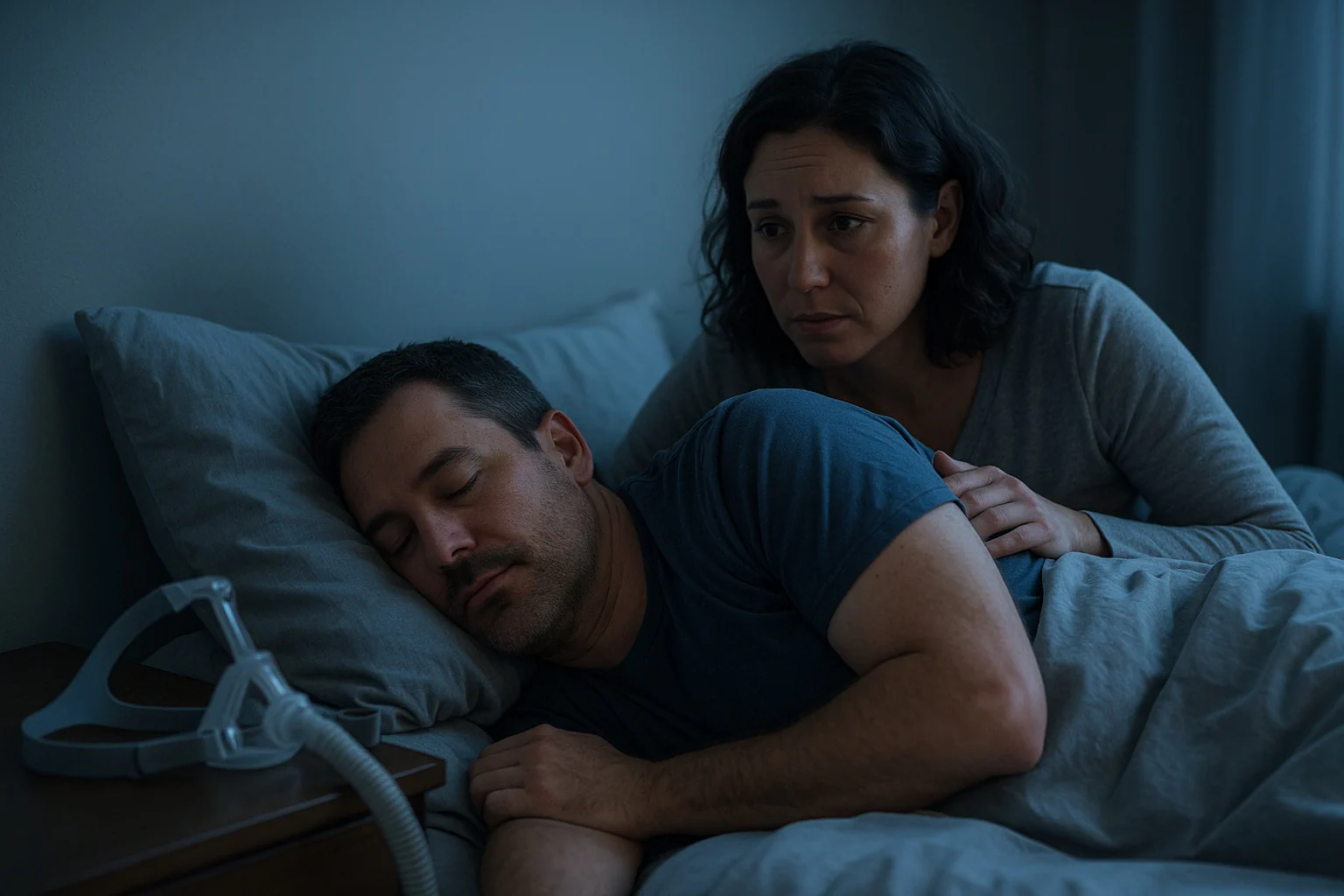
Screen your obstructive sleep apnea risk. This sleep apnea risk calculator reviews symptoms like snoring, sleepiness, and observed pauses in breathing.
This sleep apnea risk calculator is a quick symptom-first screen for the signals that usually travel with obstructive sleep apnea — snoring, daytime tiredness, witnessed breathing pauses and the body factors that narrow an airway. It is fast to complete on a phone and designed to help you have a clearer conversation with a clinician. If you specifically want the validated eight-item instrument used in pre-operative clinics, with its sex-specific neck thresholds and the 2016 refinement for borderline totals, use the dedicated STOP-BANG calculator instead.
What is obstructive sleep apnea (OSA)?
Obstructive sleep apnea is a condition where the airway narrows or collapses during sleep, causing pauses or shallow breathing. These breaks can fragment sleep and reduce oxygen levels. People often notice loud snoring, gasping, or frequent awakenings; partners sometimes observe the breathing pauses directly. Daytime effects can include sleepiness, low energy, morning headaches, and trouble with focus. OSA ranges from mild to severe and can affect adults of all ages and body types.
Screening tools can’t diagnose OSA, but they can point out patterns that deserve a closer look. If your score is intermediate or high, that does not mean you “have” sleep apnea — it means a medical professional might recommend further evaluation, such as a home sleep apnea test (HSAT) or a full overnight study in a sleep lab.
Which screening method this tool uses
The eight risk signals checked here follow the same evidence base as the STOP-BANG questionnaire: four reported symptoms (snoring, tiredness, observed apneas and blood pressure) and four body factors (body mass index, age, neck circumference and sex at birth). Each positive answer adds one point, and totals of 0–2, 3–4 and 5–8 map to low, intermediate and high risk of moderate-to-severe OSA.
This page keeps that scoring deliberately simple. If you need the instrument exactly as clinicians apply it — the sex-specific 43 cm and 41 cm neck thresholds rather than a single 40 cm cut-off, the published sensitivity and specificity figures, and Chung’s 2016 rule that escalates a borderline 3 or 4 to high risk when at least two symptom items are positive — work through the dedicated STOP-BANG calculator, which reports the STOP and BANG subscores separately.
Inputs you’ll enter and how to measure them
You’ll answer the four STOP questions with simple Yes/No choices. For the BANG items, you’ll enter age, height and weight to compute BMI, neck circumference, and sex assigned at birth. If you don’t know your BMI, the calculator computes it for you from height and weight. Neck size can be measured with a flexible tape just below the Adam’s apple or at the widest part of the neck.
Unsure about your BMI? You can also check it aside with our adult BMI calculator. If snoring is your main concern, try the snoring calculator to reflect on patterns, triggers, and possible remedies.
How to use the sleep apnea risk calculator
The tool is mobile‑first. Choose units, enter age, height and weight (or let your device fill saved data), measure neck, and answer the STOP questions. You’ll immediately see your STOP‑Bang score, a color‑coded risk label, and a point‑by‑point breakdown. Nothing is stored — if you refresh or leave the page, your entries are cleared.
If you’re also optimizing sleep timing, our sleep calculator and bedtime calculator can help you plan schedules around your morning obligations. To gauge how well you use time in bed, see the sleep efficiency calculator and for a broader snapshot try the sleep score calculator.
Reading your score and risk level
A total of 0–2 suggests low risk, 3–4 intermediate, and 5–8 high. The breakdown shows what influenced your result — for example, snoring plus observed pauses and a neck over 40 cm will raise the score even if your BMI is modest. Remember that STOP‑Bang is a screening tool, not a diagnosis. High scores indicate a higher chance of OSA in studies, not certainty for any one person.
If your score is intermediate or high, consider speaking with a clinician. A brief appointment can review symptoms and medical history and decide whether testing makes sense now. Early evaluation is particularly helpful if you’ve had daytime sleepiness affecting driving or work safety, if your blood pressure is difficult to control, or if you wake with gasping or morning headaches.
STOP‑Bang answers “how likely is OSA?” but it does not quantify how sleepy you actually are, and the two measures agree surprisingly poorly — ESS scores correlate with the apnea‑hypopnea index at roughly 0.2. Pairing this screen with the Epworth Sleepiness Scale calculator gives a clinician both halves of the picture: a STOP‑Bang of 5 alongside an ESS of 14 is a much stronger case for a sleep study than either number alone.
Practical ways to lower risk signals
While only testing can confirm OSA, several everyday factors influence STOP‑Bang items. Weight management can lower BMI and sometimes reduce snoring. Nasal congestion management and alcohol timing may help snoring and awakenings. If you suspect high blood pressure, getting it measured and treated can improve overall cardiovascular health and may reduce related risk flags in the score over time.
Building reliable sleep habits also matters. If you want to understand short nights and catch‑up behavior, the sleep debt calculator can highlight accumulated shortfalls and guide gentle course‑corrections. To plan wake times that avoid heavy grogginess, try the REM sleep calculator, which suggests windows that often feel lighter to wake from.
Home sleep apnea testing (HSAT) vs. in‑lab studies
If your clinician recommends evaluation, options typically include a home sleep apnea test (HSAT) or an in‑lab polysomnography (PSG). HSAT is convenient, less expensive, and focuses on breathing‑related signals that are most relevant to OSA. In‑lab studies capture more detail about sleep stages and related conditions, and they’re preferred for complex cases or when HSAT is inconclusive.
The right choice depends on your medical history, other sleep concerns, and local practice. Your STOP‑Bang score is just one piece of the puzzle that can help guide that conversation.
When to seek help (informational)
This site provides tools and general information, not medical advice. If you experience loud snoring with choking or gasping, witnessed apneas, morning headaches, or excessive sleepiness that jeopardizes safety, consider speaking with a clinician. If you already have heart or metabolic conditions, earlier evaluation can be particularly helpful.
Helpful tools and quick links
- Snoring calculator — reflect on patterns and possible contributors.
- Adult BMI calculator — double‑check BMI alongside this tool.
- Sleep efficiency calculator — time in bed versus time asleep.
- Sleep score calculator — a simple, holistic scorecard.
- Sleep debt calculator — visualize shortfalls after busy weeks.
- Bedtime calculator and wake‑up time calculator — align sleep with your mornings.
Resources & evidence
STOP‑Bang is one of the most commonly used screening approaches for suspected OSA in clinical and peri‑operative settings. For background and validation work, see the STOP‑Bang resources and guidance from professional organizations:
- STOP‑Bang official resources— background, scoring, and educational materials.
- American Academy of Sleep Medicine (AASM)— clinical practice guidelines and patient information.
Nothing here replaces medical advice. Use this sleep apnea risk calculator to organize your thoughts and decide if a chat with a clinician could be helpful. Many people find that a short discussion, plus a simple home test when appropriate, brings clarity and relief.

Written by Marko Šinko
Co-Founder & Lead Developer
Computer scientist and developer working on calculator implementation, data handling, and accessible interfaces. His authorship describes development work, not independent medical review.
View full profileFrequently Asked Questions
How reliable is this sleep apnea risk calculator?
It uses the widely adopted STOP‑Bang screening method. A higher score means a higher likelihood of obstructive sleep apnea in studies, but only a sleep study can diagnose OSA.
What STOP‑Bang score is considered high risk?
Commonly, 0–2 is low risk, 3–4 is intermediate, and 5–8 is high risk. Some clinical pathways add extra rules, but this summary works well for general screening.
Does BMI or neck circumference really matter?
Yes. BMI ≥ 35 and neck circumference over 40 cm are associated with higher OSA risk in population studies and each adds a point in STOP‑Bang.
Is this the same as a diagnosis?
No. This tool screens for risk only. If your score is intermediate or high, consider discussing a home sleep apnea test or in‑lab study with a clinician.
Why does male sex at birth add a point?
Men have a higher prevalence of OSA, so STOP‑Bang assigns one point for male sex at birth. Women can still have OSA, especially after menopause.
Related Calculators
ADHD Test: Free Adult ASRS Screening Score, 18 Items
Free ADHD test using the WHO ASRS v1.1 screener. Answer 18 questions, score Part A against the cut-off of 4, then rule out the four conditions that mimic it.

Anxiety Calculator: Test Your Anxiety Symptom Level
Use our anxiety calculator to rate seven common symptoms, see your severity band, and get practical next steps you can try today. Free and completely private.
AUDIT Alcohol Calculator — Score Alcohol Use Disorder Risk
Use the AUDIT alcohol calculator to score the 10-item screening test, grade hazardous or dependent drinking risk, and see your zone-based intervention level.
Autism Test: Free AQ-10 Adult Screening Score (0-10)
Free autism test using the AQ-10 screening questionnaire: score 10 items against the 6-point cut-off and see what a positive result really means for you.

Bedtime Calculator: Find the Best Time to Go to Bed Now
Enter your wake time and the bedtime calculator suggests bedtimes by 90-minute cycles. Add a fall-asleep buffer and choose 12/24-hour time for better mornings.

Circadian Rhythm Calculator: Align Sleep & Wake Times
Use the Circadian Rhythm Calculator to identify your chronotype and align sleep and wake times. See optimal windows, plan meals, and get blue-light tips.